

Prime Minister Narendra Modi’s December 21, 2025 visit to Guwahati’s Swahid Smarak Kshetra transformed the memorial’s public significance. The event, announced through official posters specifying his 9:45 AM arrival, elevated a tribute to regional sacrifice into a site of national recognition.
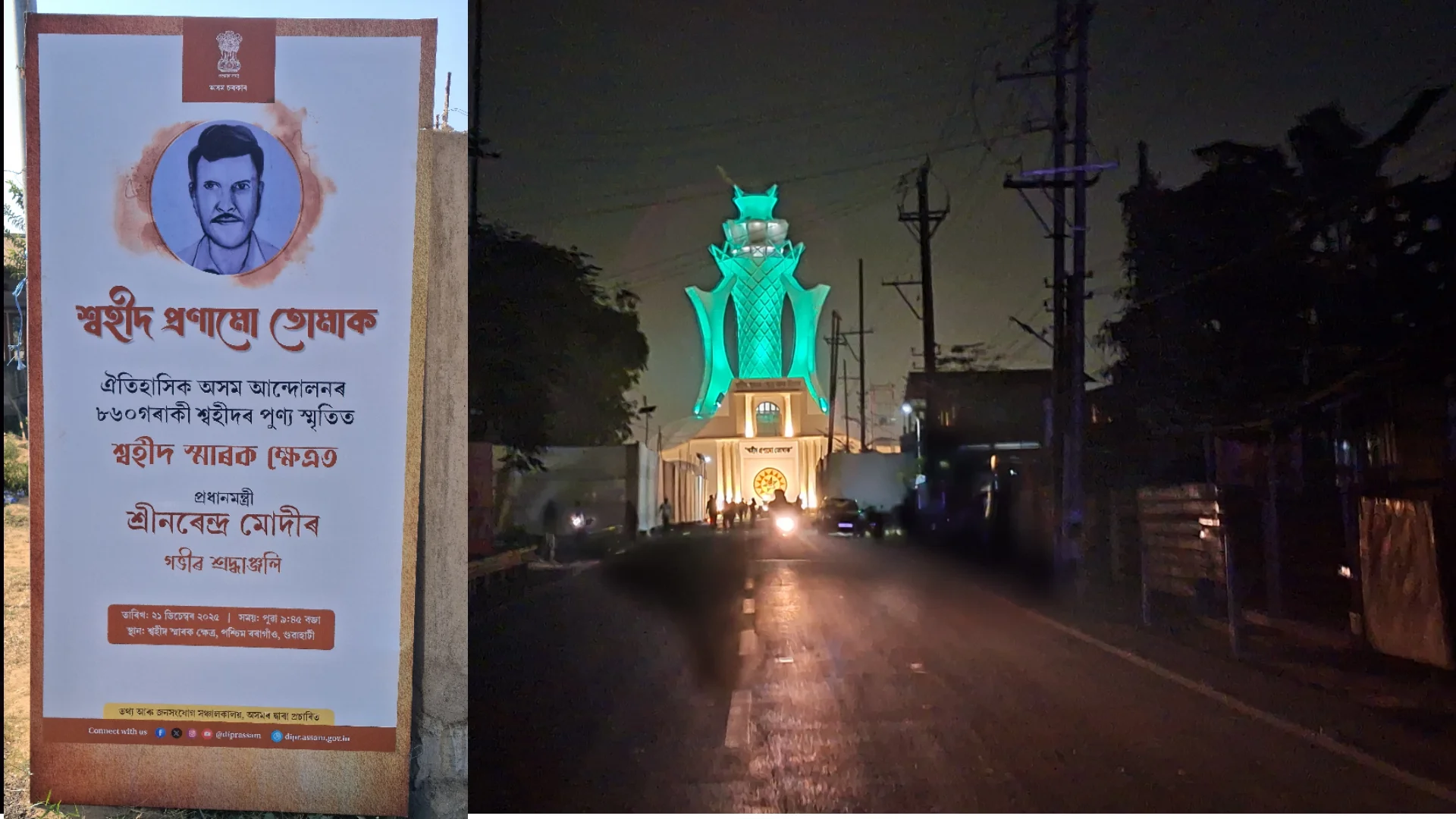
The convergence is now official. As the memorial’s 225-foot tower stands illuminated against the night sky, the posted announcement makes clear what was once speculation: a landmark of regional memory is becoming a site of national significance.
The Moment of Convergence: National Leadership Meets Regional Memory
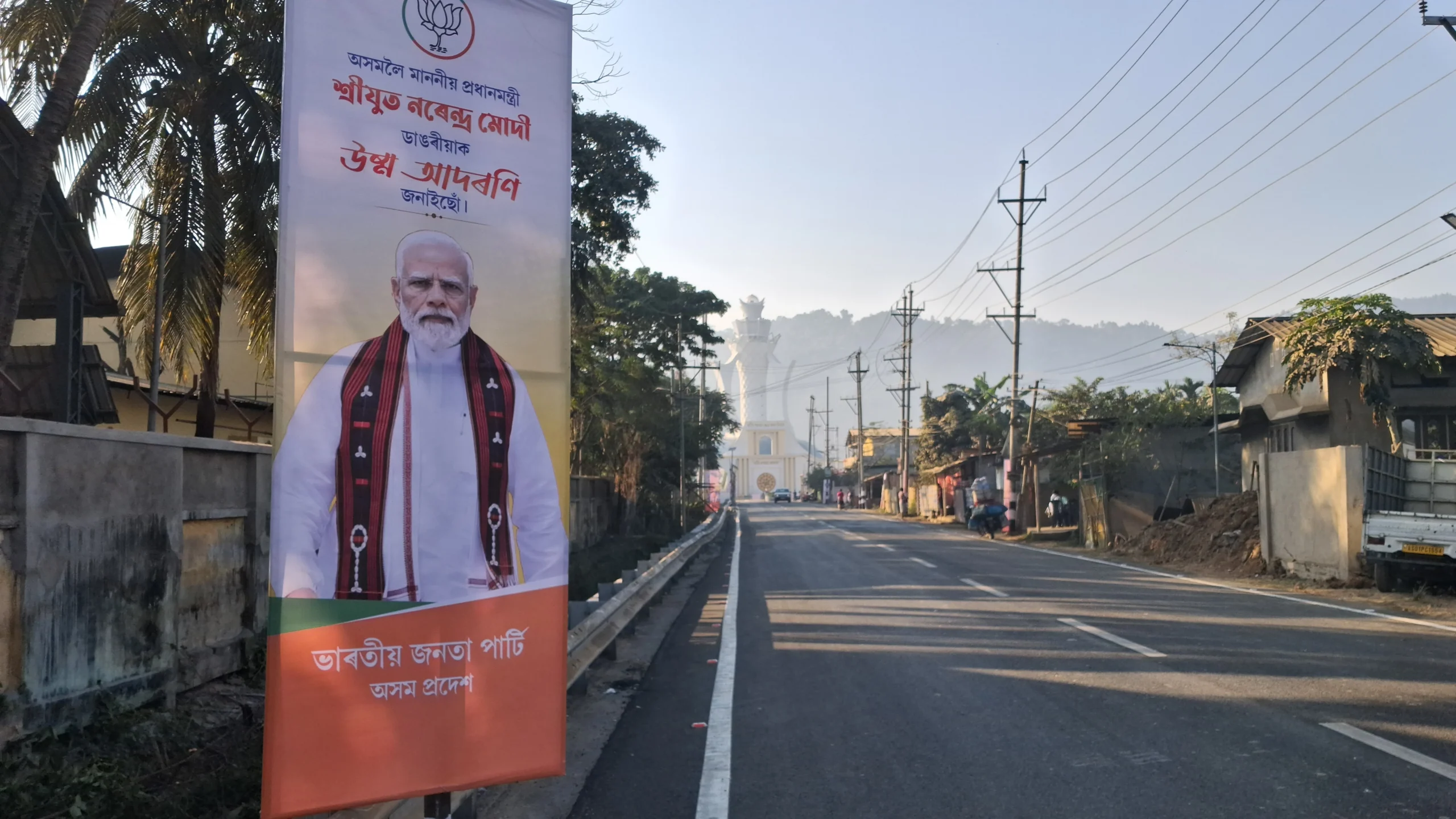
A Strategic Stop on the Itinerary
While the primary purpose of the Prime Minister’s visit to Guwahati centered on inaugurating the new airport terminal—a vital infrastructure milestone for Northeast India—the deliberate inclusion of the Swahid Smarak Kshetra in the itinerary carried its own weighty message.
Official visits are carefully choreographed. Every stop is a symbol, every gesture a statement. By choosing to pay respects at this particular memorial, just weeks after its inauguration on December 10, 2025 (Swahid Diwas), a direct line is drawn between national governance and regional historical memory. This is more than a photo opportunity; it is an act of political acknowledgment and cultural validation.
The visit serves multiple layers of significance:
- Recognition of Sacrifice: It formally acknowledges the sacrifice of the 860 martyrs of the Assam Movement at the highest level of national leadership.
- Endorsement of Narrative: It lends the weight of the central government to the historical narrative preserved at the site, which centers on the protection of indigenous identity.
- Symbolic Unity: It visually connects national progress (the airport) with regional memory (the memorial), presenting a vision of development that does not forget the past.
Swahid Smarak Kshetra: A Quick Primer for a National Audience
For a national audience newly curious about this site, a brief explanation is in order.
The Swahid Smarak Kshetra is not merely a park or a statue. It is Assam’s first unified, state-sanctioned memorial dedicated to the martyrs of the Assam Movement (1979-1985), a six-year-long democratic agitation centered on protecting the cultural and demographic identity of the indigenous population.
In Essence:
- What it is: A 116-bigha (38-acre) commemorative complex in Paschim Boragaon, Guwahati.
- Its Core Purpose: To honor the 860 individuals who lost their lives during the movement.
- Its Architectural Heart: A 225-foot central tower with abstract figures, symbolizing collective resilience.
- Its Emotional Core: The “Hall of Fame,” which aims to house individual tributes to each martyr, and the underground “Roll of Honor.”
For visitors and history enthusiasts seeking a deeper understanding of the movement’s history and a detailed guide to the memorial’s architecture, our definitive guide to the Swahid Smarak Kshetra offers a comprehensive exploration.
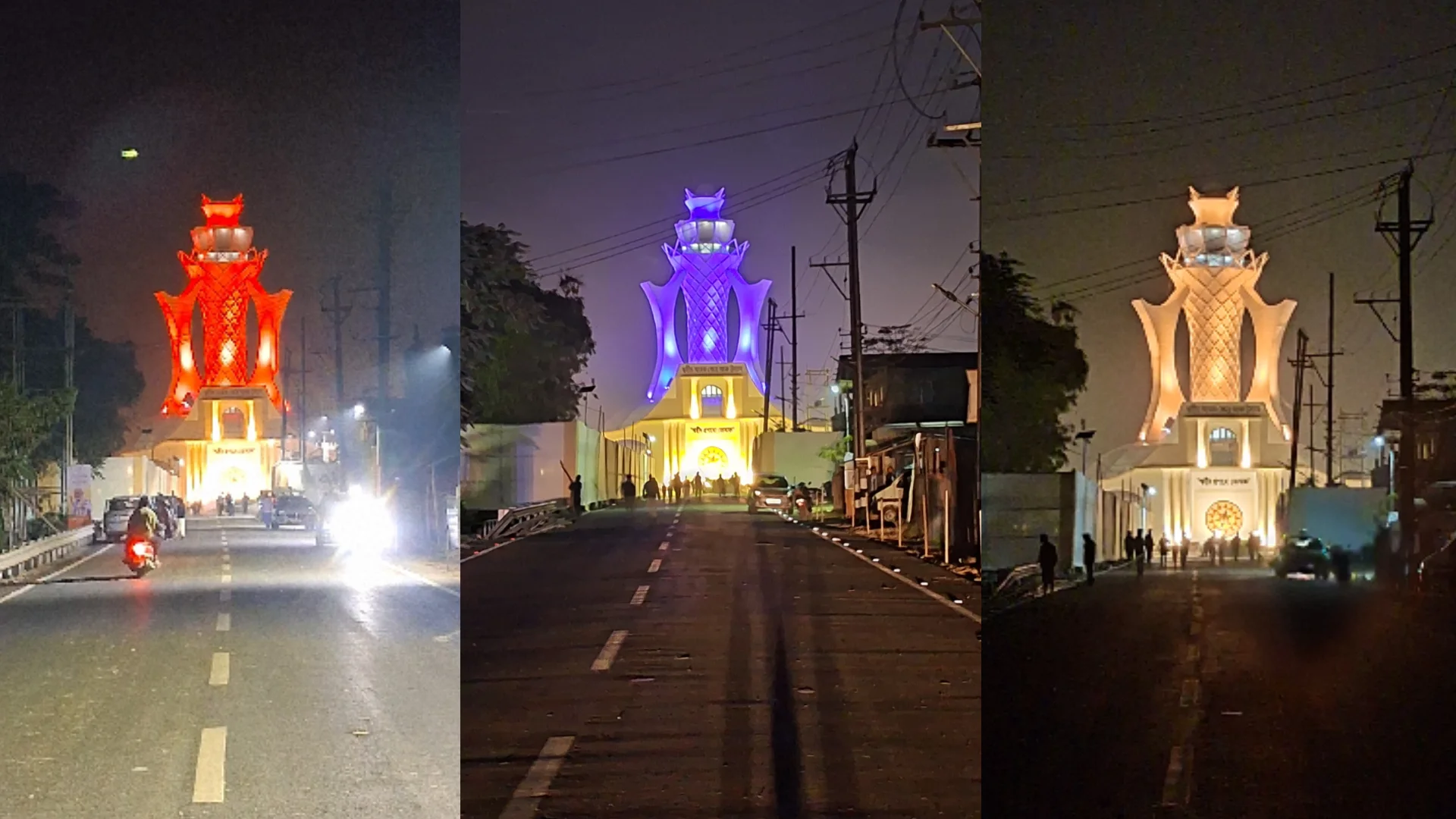
Beyond its daytime solemnity, the Swahid Smarak Kshetra commands attention after dark. Its chromatic light sequence ensures the memorial remains a visible beacon in Guwahati’s nightscape—a fitting backdrop for high-profile attention.
Beyond the Headlines: The Deeper Implications
The spotlight from a Prime Ministerial visit transforms a landmark. For the Swahid Smarak Kshetra, this means a likely acceleration of its journey from a revered regional site to a point of interest on the national tourism and cultural map.
The “Spotlight Effect” on Tourism
High-profile visits act as the ultimate certification for a destination. The memorial is now poised to see a significant increase in visitors, not just from within Assam but from across India. This aligns perfectly with its design as a multi-faceted public space—combining solemn remembrance (the Hall of Fame) with community engagement (the food court, cycling track, and laser show).
Connecting Memory to Contemporary Discourse
The visit inevitably links the memorial’s historical context to ongoing national conversations about cultural preservation, integration, and identity. The Assam Movement was fundamentally about these themes, and the memorial stands as a permanent reference point for these discussions. Its prominence reinforces the continuing relevance of the Assam Accord (1985) and related matters of policy.
A Boost for Commemorative Tourism in the Northeast
The Northeast is rich in living history and cultural memory, though not all are memorialized on such a scale. This visit highlights the importance of “commemorative urbanism”—the integration of historical memory into the civic landscape—and may inspire similar thoughtful projects across the region.
What This Means for Visitors: Updated Practical Advice
With increased national attention, the visitor experience is likely to evolve. Here’s what potential visitors should know in the wake of this spotlight.
Expect and Plan for Increased Crowds
The memorial was already drawing large numbers since its inauguration. The PM’s visit will amplify this interest. Strategic timing is now more crucial than ever.
- Best Time to Visit: Weekday mornings remain your best bet for a contemplative experience.
- Weekend Caution: Expect significantly larger crowds on weekends, especially around the afternoon and evening laser show timings.
The Parking Pro-Tip is Now Essential
Our previously shared local advice has graduated from a tip to a necessity. The designated parking lanes on the NH-37 bypass are almost certain to be overwhelmed.
- The Smart Strategy: As you approach the memorial, look for secure, legal parking at least 500 meters before the main gate. The short walk will save you from a near-guaranteed traffic bottleneck when leaving. This simple step can be the difference between a smooth visit and a frustrating ordeal.
Stay Updated on Logistics
High-profile events can lead to temporary adjustments in operation.
- Check Before You Go: It is advisable to verify the latest opening hours and any special visitor guidelines by checking the Guwahati Metropolitan Development Authority (GMDA) website or reliable local news sources before your trip.
- Respect the Space: Remember, despite the increased popularity, this remains first and foremost a place of respect and remembrance. Visitor conduct should be in keeping with the site’s dignified nature.
Conclusion: A Landmark’s National Arrival
Prime Minister Modi’s visit to the Swahid Smarak Kshetra marks a definitive moment in the memorial’s young life. It signals a convergence of narratives—where a powerful story of regional sacrifice is embraced and acknowledged within the broader national story.
For Assam, it is a moment of validation for a history deeply felt. For the nation, it is an invitation to understand a pivotal chapter in the life of its northeastern frontier. And for the visitor, it unveils a destination that has, almost overnight, become a significant touchstone for anyone seeking to comprehend the complex, resilient spirit of modern India.
The Swahid Smarak Kshetra is no longer just Guwahati’s new monument. The national spotlight has confirmed its role as a national memorial, ensuring that the memory it guards and the values it represents will resonate far beyond the banks of the Brahmaputra.
About the Author: This analysis was prepared by the editorial team at Best of Northeast. For more deep dives into the culture, history, and travel secrets of India’s northeastern states, explore our guides on the Kamakhya Temple, the Assam State Museum, and the cultural hub of Kalakshetra.

A really good blog and me back again.