
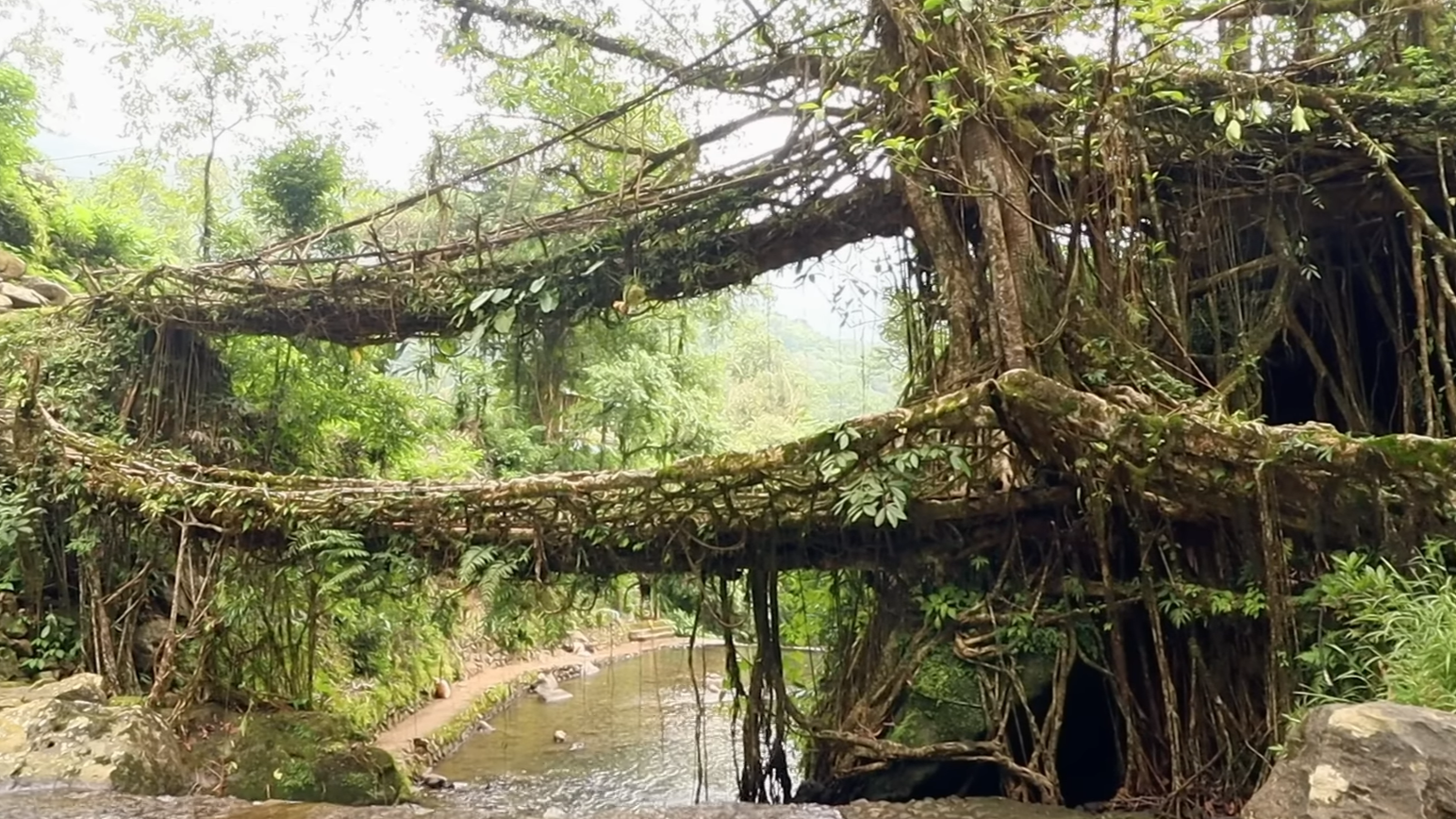
You’ve seen the photo: two tiers of living roots stacked over a quiet jungle stream. What the photo doesn’t show is the staircase, and the climb back. Meghalaya Tourism puts the descent from Tyrna at approximately 3,500 stone steps, and you walk the same steps out. So the real planning question for the double-decker living root bridge trek isn’t whether it’s worth it. It’s whether you can do it in a day or should stay the night
This guide brings together public sources, reports from a recent visitor couple and a local trekking guide, and our own planning arithmetic. We’ve kept three things apart: what is official, what one person reported, and what we couldn’t confirm.
One real example of the planning challenge: a recent visitor couple planned to leave their Sohra accommodation after the trek, but extended their stay once the climb back left them tired. They didn’t stay overnight in Nongriat, and it’s one trip, but it shows what a day trip can cost the following day.
Before You Plan: The Rules and What Is Still Unclear
Do you need a guide to experience Double-Decker Living Root Bridge Trek?
Yes. The official notice is clear. On 30 June 2025 the Deputy Commissioner of East Khasi Hills, who chairs the District Tourism Promotion Society, announced that it is mandatory for tourists to take tourist guide services while trekking, for safety reasons (government press release). Treat that as the rule and arrange a guide. Meghalaya Tourism also advises arranging a local guide.
The release doesn’t list individual trails or explain how to book a guide or what to pay, so ask your hotel or homestay to point you to one before you go. According to a local guide, there is a staffed meeting point near the Tyrna tourism and parking gate, and you should confirm the destination, the services and the total price before you set off. He added that a guide matters most beyond Nongriat, where mobile reception and finding the way get harder.
Is the Nongriat trek closed on Sundays?
Treat the reported Sunday closure as an important warning. A local operator’s website says the double-decker trek has been closed to tourists on Sundays, by the village, since January 2021 (operator’s page, last updated in 2021). A local guide described the closure as strictly observed.
We couldn’t find an official notice about it, and our sources don’t say how it applies to guests staying in the valley. So don’t plan a Sunday visit, and confirm access with your guide or homestay before you commit to any dates. The same operator says its own rainforest trek to the Umunoi and Umkar root bridges stays open on Sundays and takes about three hours round trip.
Double-Decker Living Root Bridge Trek at a Glance
Where: Nongriat village, about 15 km from Cherrapunji (Sohra), according to Meghalaya Tourism. Some trip guides put Tyrna itself about 20 km from Sohra by road.
Trailhead: Tyrna, a 30 to 45 minute taxi ride from Sohra, per Meghalaya Tourism. Coming from Guwahati? Our Guwahati to Cherrapunji road-trip guide covers the drive to Sohra.
Guide: required. The East Khasi Hills notice of 30 June 2025 makes tourist guide services mandatory while trekking.
Steps: approximately 3,500 down. The same Meghalaya Tourism page also says 3,000, so expect some variation.
Walking time: one 2026 trip guide gives 1.5 to 2 hours down, 2 to 3 hours back up, and a 10 to 15 minute walk from Nongriat village to the bridge. These are not official figures, and slower walkers will take longer.
Best season: October to March, according to Meghalaya Tourism.
Sunset (calculator figures for Cherrapunji, 2026 to 2027 calendar): about 4:44 to 5:12 PM in October, 4:34 to 4:44 PM in November, 4:34 to 4:46 PM in December, 4:45 to 5:07 PM in January, 5:08 to 5:25 PM in February and 5:26 to 5:39 PM in March.
What Recent Trekkers Report, and What It Means for Your Plan
A recent visitor couple described one trip, and the date isn’t recorded, so treat it as an example, not a standard. Here is what they reported, with what we take from it.
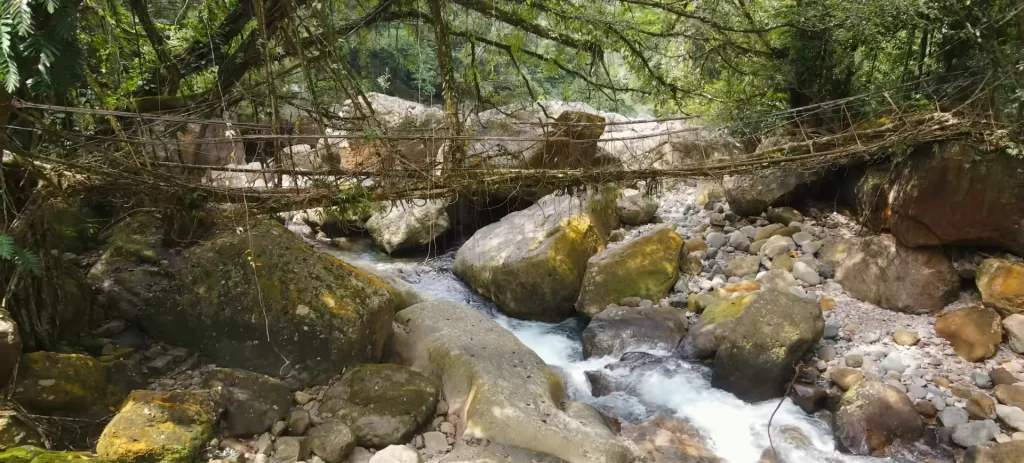
- Steep, narrow upper steps on the descent. Don’t assume the way down is quick. Plan the first stretch slowly.
- The climb back was the hardest part. That’s why our schedule below starts from the turn-back time and works backwards.
- Rain, heavy humidity and afternoon fog. Treat any sunset margin as a minimum, and avoid being on the stairs near dusk.
- Rented bamboo sticks at Tyrna, especially helpful on the way back. Worth it if your knees worry you.
- Water and snacks available in the valley, but at higher prices. Carry your own.
- They didn’t stay overnight in Nongriat, and they extended their Sohra stay afterwards. See the example below.
The stay that got extended
This is the most useful detail in their account. They had planned to leave their Sohra accommodation after the trek. After the descent and, above all, the climb back, they were tired enough to extend their stay instead. It’s one couple’s trip, not a rule. But it shows that the cost of a day trip doesn’t end at the top of the stairs. If you plan a day trip, keep the following day flexible, and avoid booking a long drive or a tight onward connection straight afterwards.
What the smartwatch reading does and doesn’t tell us
One of them recorded 3.11 km, about 400 m of climbing and 90 minutes on a smartwatch for the section from a junction near Nongthymmai back up to Tyrna. That is one section, from one person’s watch, and we haven’t seen the export. Because it covers only part of the climb, it suggests the full climb from the bridge takes longer than 90 minutes. That is consistent with the 2 to 3 hours in published trip reports, but it doesn’t confirm that range.
One of the two, without the other, carried on from the double-decker bridge to Blue Lagoon (about 30 minutes) and then to Rainbow Falls (about another hour), by rough estimate. On that account the walk is about 1.5 hours each way, but it’s one visitor’s estimate. The 2026 trip guide gives 1 to 1.5 hours each way and says to add 2 to 3 hours to your day, so the two accounts roughly agree. The local guide said fitness, daylight, trail conditions and pace should decide whether to attempt Rainbow Falls on a day trek.
Day Trip or Overnight? A Conservative Early-Start Example
Instead of asking how late you could start, we’ve worked from a deliberately early start and added time for breaks and delays. Use the table as an example of how the day adds up, not as a schedule. Your guide may advise a different start, or turning back sooner, and you should follow that advice.
Here are the assumptions, so you can swap in your own:
- Start: 7:00 AM from Tyrna. One published 2026 trip guide suggests starting between 6:30 and 8 AM.
- Descent: 1.5 to 2.5 hours. Published guides say 1.5 to 2 hours, and we allow up to 2.5 for a slower walker.
- Time at the bridge: 1 hour (our assumption).
- Climb: 2 to 3 hours (published trip reports; the visitor’s 90-minute section is consistent with this).
- Breaks: 45 minutes in total across the day (our assumption).
- Rainbow Falls: about 3 hours of round-trip walking, the top of the published 2 to 3 hour range and close to the visitor’s figures, with no time at the falls.
- Light: a mid-December sunset of 4:35 PM, with a 60-minute margin, so we’d want to be back at Tyrna by about 3:35 PM.
Fit walker, no Rainbow Falls (1.5 h down, 1 h at the bridge, 2 h up, 4.5 hours in all): back at Tyrna about 12:15 PM from a 7 AM start with breaks, or about 1:15 PM if you lose an extra hour. A comfortable margin.
Average walker, no Rainbow Falls (2.5 h down, 1 h at the bridge, 3 h up, 6.5 hours): about 2:15 PM, or about 3:15 PM with an extra hour lost. Workable, but a delay uses up the slack.
Fit walker with Rainbow Falls (adds about 3 h, 7.5 hours): about 3:15 PM, or about 4:15 PM. Tight, with little light to spare.
Average walker with Rainbow Falls (9.5 hours): about 5:15 PM, or about 6:15 PM. Doesn’t fit in daylight.
Sunset also isn’t the same as dark, and we’d assume the light fades earlier under the forest canopy. You also need to reach Tyrna and meet your guide before you start. In March, with sunset about 5:30 PM, there is roughly an hour more slack. Whatever the calculations suggest, the guide’s advice on the day comes first.
A Two-Day Overnight Example
- Day 1: Start early from Tyrna with your guide and descend at a comfortable pace. Visit the double-decker living root bridge and settle into a pre-booked Nongriat homestay. Visit Rainbow Falls only if time, fitness, weather and your guide’s advice allow.
- Day 2: Begin the return climb early, allow sufficient breaks and avoid tight onward travel arrangements.
This is an example, not a fixed schedule. If your dates include a Sunday, confirm access with your guide or homestay first.
What the example shows
A fit walker who starts early has hours of slack without Rainbow Falls on a December day.
An average walker or beginner can finish a day trip on paper, but one delay uses up the margin. Staying overnight spreads the effort over two days.
Rainbow Falls leaves little or no slack even from a 7 AM start, and doesn’t fit for an average walker in December. We’d treat it as an overnight extra.
Sundays: given the reported closure, we wouldn’t plan a day trip on a Sunday. For any overnight that touches a Sunday, check access with your guide or homestay first.
Who should do what
- Strong walker, on a day the trek is open, no Rainbow Falls: a day trip is realistic. Start early, take the guide’s advice, and agree your return ride in advance.
- Average fitness or beginners: an overnight stay makes the schedule less pressured, if you can confirm a place to sleep and access on your dates. If you can’t, choose another date.
- Want Rainbow Falls: stay overnight.
- Monsoon, June to September: we’d skip it. Meghalaya Tourism advises checking daily forecasts for heavy rain and landslide warnings.
Does staying overnight make the living root bridge trek easier?
It reduces the pressure to finish everything in one day, but it doesn’t make the trek itself easier. You still walk down roughly 3,500 steps and climb back up them, and the climb is still the hardest part.
If you have knee, heart, breathing or balance problems, or you’re uneasy on swaying suspension bridges, an overnight stay doesn’t remove those risks. Get medical advice before you decide, be frank with your guide about your pace and limits, and be ready to choose a gentler outing instead. A luggage porter, which one local guide described (see the costs below), can lighten your load but not the climb.
One caution on the evidence. The visitors didn’t stay overnight in Nongriat, so the case for staying rests on the arithmetic above, not on anyone’s experience of a night there. We also haven’t verified any homestay, its availability or its prices. Meghalaya Tourism notes that winter is a busy season and advises booking accommodation in advance.
What Does It Cost? 3 Separate Sets of Figures
There is no single standard cost, and we haven’t added these together. They come from three kinds of source, so we’ve kept them apart. Other published guides, such as the 2026 trip guide, also mention a small entry fee at the bridge, parking and camera charges, but don’t give consistent amounts. Carry cash for all of it, because connections in the valley are unreliable.
Payments reported by a recent visitor
Rates may have changed.
| Item | Amount reported | Note |
| Parking at Tyrna | ₹50 | One reported payment |
| Bamboo walking sticks | ₹30 each | Two rented |
| Single-root living root bridge admission | ₹30 per adult | Reported at one crossing |
| Double-decker living root bridge admission | ₹50 per person | Reported on their visit |
| Bottled water inside the valley | ₹30 to 40 | An example, not a fixed price |
Rates described by one local guide
This is not an official rate card. Agree your own quote before you set off.
| Service | Range described | Unit |
| Tyrna, root bridges and back | ₹600 to 800 | Per group |
| Circuit including Rainbow Falls | ₹1,000 to 1,500 | Per group |
| Overnight escort with return the next day | ₹1,500 to 2,500 | Per group |
| Luggage porter (up to about 15 kg) | ₹500 to 800 | Per bag |
Previously Advertised Nongriat Trekking Packages
An older Meghalaya Tourism listing featured the following packages from Pioneer Adventure Tour. However, the prices are not displayed on the current tourism website (Meghalaya Tourism page), and we could not independently confirm whether these packages or rates are still available. Call the helpline (1800 599 2026) and WhatsApp (+91 76400 03050) to confirm current price.
| Package | Previously listed price | Advertised inclusions |
| Pioneer Adventure Tour, two days and one night | ₹2,800 per head | Three meals, bonfire, river-side camping and a trekking guide |
| Pioneer Adventure Tour, river-side camping | ₹2,200 per head per night | Camping package; current inclusions need confirmation |
What to Pack for Nongriat trek
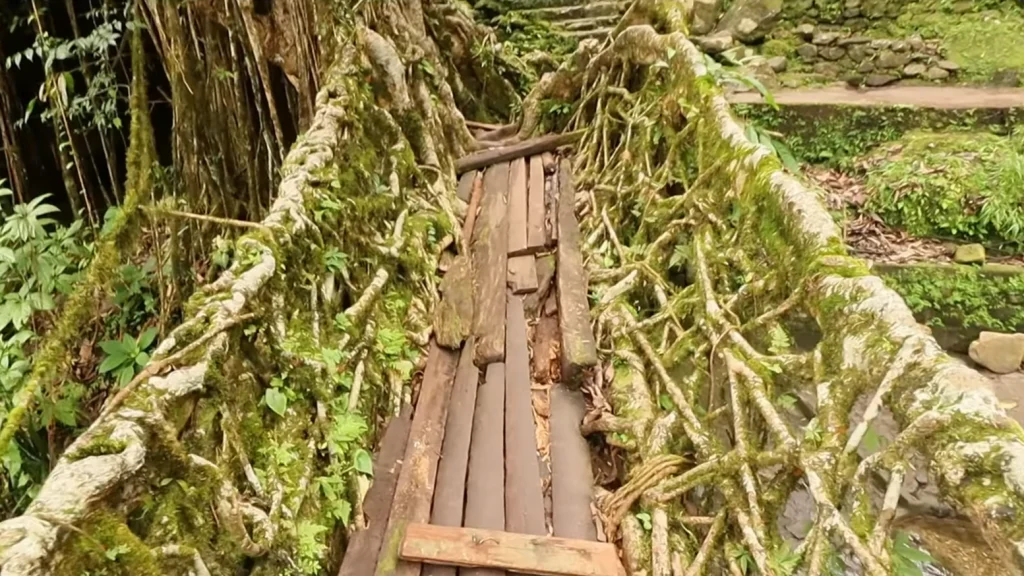
- Shoes with real grip. Not sandals.
- Water and snacks, since they cost more in the valley.
- Cash.
- A rain jacket, because the couple met rain and afternoon fog.
- A power bank and an offline map.
- A walking stick. They can be rented at Tyrna.
What We Couldn’t Confirm
Whole Nongriat trek timings. We have published ranges and one measured section, not an official timing.
How the Sunday closure applies to overnight guests. Our sources don’t say.
Current admission, parking and guide rates. No official rate sheet was available to us, so the figures above are examples.
Step count. Meghalaya Tourism’s own page gives both 3,500 and 3,000.
Homestay availability and prices in Nongriat.
An official guide-booking procedure and published standard tariff. The guide-provided rates above are indicative quotations, not verified official prices.
The Climb Back Is the Plan
The descent will feel easy, and that is the trap. If you’re planning the double-decker living root bridge trek, plan the day backwards from the climb: how long it could take you, how much light you’ll have left and what happens if you’re slow. If those sums leave you no margin, stay the night, or choose a longer day with an early start. And whichever you choose, agree your guide and your ride back before you go down.
Planning more of your Meghalaya trip? Explore our Meghalaya guides, plan the drive with our Guwahati to Cherrapunji road-trip guide, or browse our where-to-stay guides.