
Quick Answer: Can Civilians Visit Doklam and Cho‑La?
Yes. Under the Bharat Ranbhoomi Darshan initiative launched in December 2025, Doklam and Cho‑La Pass in East Sikkim are now open to domestic tourists. However, strict regulations apply on Doklam & Cho-La Pass battlefield tourism:
- Indian nationals only – foreigners are not permitted.
- Mandatory 1‑night homestay in a designated Silk Route village (Zuluk, Kupup, Nathang, or Padamchen).
- Vehicle engine requirement – 1400cc or higher for cars; bikes require special permission and convoy supervision.
- Permit fee – ₹1,120 per person plus vehicle charges.
- Daily caps – 25 vehicles + 25 bikes per site.
This guide covers everything: historical significance, step‑by‑step permits, vehicle rules, the mandatory homestay, altitude safety, costs, and what the experience actually feels like.
Why Doklam and Cho‑La Pass Battlefields Matter
The Strategic Chumbi Valley
Doklam and Cho‑La pass are located in the Chumbi Valley, a narrow wedge of territory that sits at the tri‑junction of India, China, and Bhutan. This region directly overlooks the Siliguri Corridor – India’s slender “chicken’s neck” that connects the mainland to the seven northeastern states. Control over this area has been a strategic obsession for decades.
The 1967 Cho‑La Conflict: A Decisive Indian Victory
Five years after the traumatic 1962 Sino‑Indian War, tensions flared again on the Sikkim‑Tibet border. In September 1967, clashes began at Nathu La; by October 1, the fighting spread to Cho‑La Pass. This time, the Indian Army was prepared.
Units like the 7/11 Gorkha Rifles and 10 Jammu & Kashmir Rifles engaged in fierce close‑quarter combat. The Indian response was so overwhelming that Chinese forces were forced to retreat nearly three kilometers to Kam Barracks. The victory restored morale and established a lasting deterrent along this border.
| Casualties | Indian Side | Chinese Side (Indian Reports) |
|---|---|---|
| Killed | 88 | 340 |
| Wounded | 163 | 450 |
| Outcome | Indian Victory; retention of high ground; Chinese withdrawal of ~3 km |
The 2017 Doklam Standoff: 73 Days That Changed the Border
In June 2017, Indian troops intervened to prevent Chinese engineers from constructing a road through territory claimed by Bhutan – the Doklam plateau. What followed was a 73‑day standoff, with soldiers standing chest‑to‑chest without firing a shot, reflecting modern border management. The standoff ended in August with both sides disengaging, but it fundamentally altered India’s infrastructure strategy for the region.
The decision to open Doklam for tourism in 2025 is a direct result of this standoff: it signals stability, security, and Indian administrative control.
Who Can Visit Doklam and Cho‑La Pass?
| Requirement | Details |
|---|---|
| Nationality | Indian citizens only. Foreign nationals are strictly prohibited. |
| Age | Discouraged for children under 5 and seniors over 65 due to extreme altitude. |
| Daily Caps | Doklam: 25 vehicles + 25 bikes. Cho‑La: 25 vehicles + 25 bikes. |
| Lead Time | Permits require 2–3 weeks processing during peak season. |
For foreign nationals: You are not permitted beyond Tsomgo Lake. Nathula, Gurudongmar, Doklam, and Cho‑La pass are all off‑limits. For general travel to Sikkim, refer to our Sikkim Permit Guide for e‑FRRO procedures.
How to Reach Doklam and Cho‑La Pass (Step‑by‑Step Route)
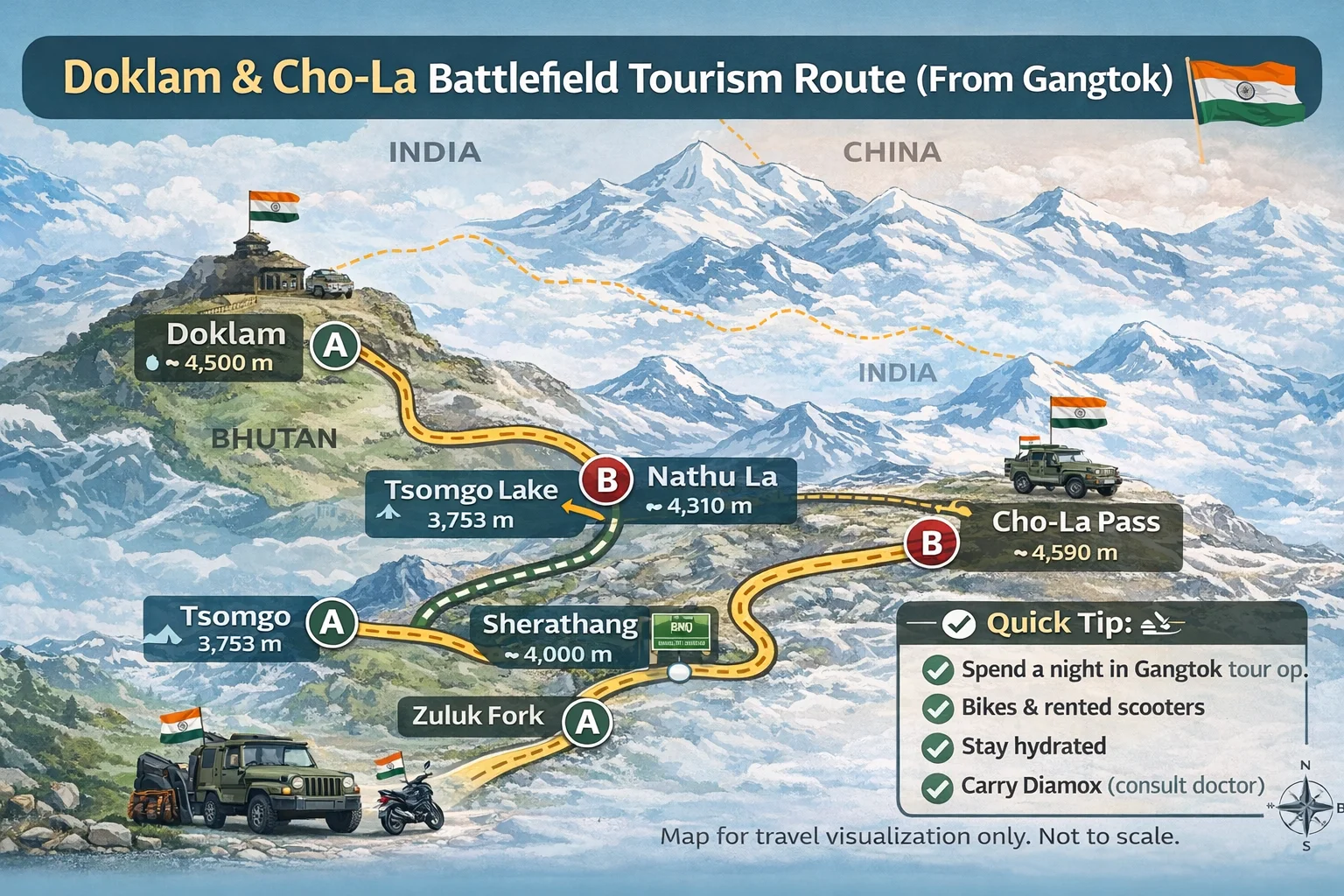
Getting to these remote border sites requires careful planning. Below is the standard route used by all registered tour operators.
Step 1: Arrive at the Gateway
| Entry Point | Distance to Gangtok | Travel Time | Notes |
|---|---|---|---|
| Bagdogra Airport (IXB) | ~120 km | 4–5 hours | Nearest airport; most convenient |
| NJP Railway Station | ~115 km | 4–5 hours | Major railhead for Northeast India |
| Siliguri Bus Stand | ~110 km | 4–5 hours | Budget option via shared jeep/bus |
From any of these, you must reach Gangtok – the capital and base for all battlefield tours.
Step 2: Gangtok to the Silk Route Villages
The battlefield circuit begins after an overnight stay in Gangtok. The next morning, you drive toward East Sikkim:
| Segment | Distance | Time | Key Points |
|---|---|---|---|
| Gangtok → Tsomgo Lake (Changu) | 55 km | 2 hours | PAP checkpoint; scenic views |
| Tsomgo → Kupup | 30 km | 1.5 hours | High‑altitude lake; world’s highest golf course |
| Kupup → Zuluk | 15 km | 1 hour | Overnight homestay mandatory here |
Note: Zuluk is the primary homestay village. Your permit requires proof of one night’s stay here or in Kupup/Nathang/Padamchen.
Step 3: Zuluk to Doklam and Cho‑La Pass
From Zuluk, the routes diverge:
- To Doklam Plateau (13,780 ft): Zuluk → Kupup → Doklam. Approximately 40 km, 2 hours. The road enters the Chumbi Valley, where the 2017 standoff occurred.
- To Cho‑La Pass (17,780 ft): Zuluk → Kupup → Baba Mandir → Cho‑La. Approximately 50 km, 2.5–3 hours. Steep ascent; oxygen cylinders recommended.
Both are day trips. You return to Zuluk or Gangtok the same evening.
Transport Options for the Doklam and Cho‑La Pass Battlefield Tourism Circuit
| Option | Feasibility | Cost (approx) | Notes |
|---|---|---|---|
| Private SUV (1400cc+) | ✅ Only option | ₹11,000–12,000 for 2 days | Must be hired through registered operator |
| Shared jeep | ❌ Not available | – | Daily caps and homestay rule make sharing impractical |
| Tour package | ✅ Recommended | ₹5,500–7,000 per person (group of 4) | Includes permits, homestay, vehicle, guide |
Important: You cannot drive your own private vehicle from outside Sikkim on this circuit. You must hire a local SUV that meets the 1400cc+ requirement and is registered with a Sikkim tour operator.
Checkpoints You Will Encounter
- Rangpo – Entry to Sikkim (permit verification for all foreign nationals and vehicle documents).
- Tsomgo Lake – PAP check; QR code scanned.
- Kupup Military Checkpost – Final verification before Doklam/Cho‑La. Army personnel may ask for ID and permit again.
Pro tip: Start from Gangtok by 6:00 AM. The checkpoints can cause delays, and afternoon weather at high altitudes is unpredictable.
Step‑by‑Step Permit Process
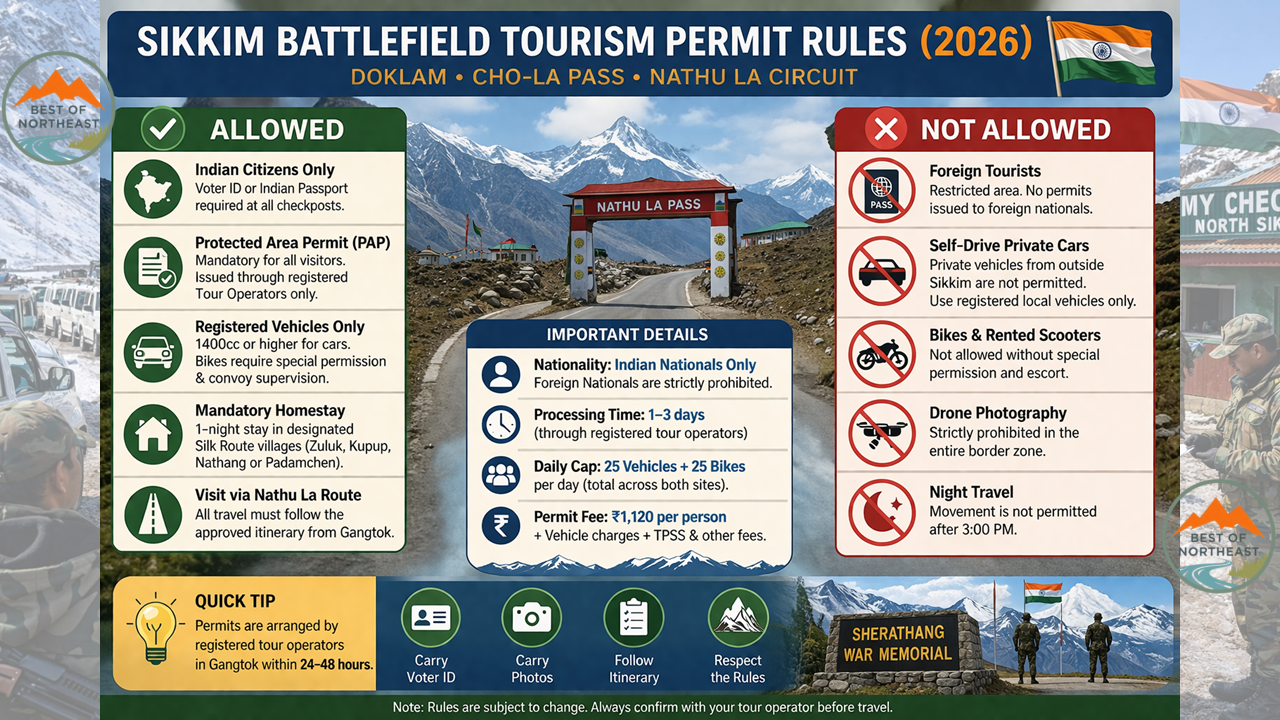
The permit for Doklam and Cho‑La pass is a Protected Area Permit (PAP) and must be processed through a tour operator registered with the Sikkim Tourism Department. Individuals cannot apply directly.
Step 1: Find a Registered Tour Operator
Choose an operator based in Gangtok or Siliguri. Even if you prefer independent travel, you can hire an operator solely for permit processing.
Step 2: Submit Documents
- Voter ID card or Indian passport (Aadhaar is not accepted at army checkposts)
- 4–6 passport‑size photographs
- Vehicle details (RC, insurance, PUC) if self‑driving – vehicle must be 1400cc+
- Your intended itinerary (including the mandatory homestay village)
Step 3: Wait for Processing
Processing time: 2–3 weeks during peak seasons (April–May, October–November); 1 week off‑season.
Step 4: Receive Digital Permit
You’ll receive a QR‑coded digital permit. Keep printed copies – mobile networks are unreliable at high altitudes.
Permit Fee Breakdown
| Fee Component | Amount (per person) |
|---|---|
| PAP Permit Fee | ₹1,120 |
| TPSS Fee (Tsomgo Pokhari Sangrakshan Samiti) | ₹20 |
| Doklam Entry Fee (Forest Dept) | ₹100 |
| Government Revenue | ₹1,000 (included in package) |
| Total | ₹2,240 approx (often bundled with vehicle & homestay) |
The Mandatory Homestay Rule (Vibrant Village Programme)
This is one of the most misunderstood requirements – and one of the most important.
To obtain a permit for Doklam or Cho‑La, you must provide proof of a one‑night homestay booking in a designated village along the Silk Route. The rule exists to ensure tourism revenue flows directly to remote border communities, incentivizing local populations to stay and thrive in these strategic areas – a core objective of the Vibrant Village Programme.
Designated Villages: Zuluk, Kupup, Nathang (Gnathang), Padamchen
What to Expect at Doklam Homestay:
- Basic but clean accommodations (shared bathrooms in some)
- Home‑cooked Sikkimese meals (thukpa, momos, dal‑bhat)
- Warm hospitality and often a chance to interact with local families
- Costs: ₹1,500–₹3,000 per night (usually includes dinner and breakfast)
Your tour operator will arrange the homestay booking as part of the permit application. You cannot book these independently for permit purposes – the operator must include it in the package.
5 Mistakes That Get Tourists Turned Back
❌ 1. Using Only an Aadhaar Card
Army checkposts do not accept Aadhaar for border zone permits. You must carry your Voter ID or Indian Passport.
❌ 2. Driving a Vehicle Under 1400cc
Cars with smaller engines are not allowed on the Doklam and Cho‑La routes. Bikes need special permission and are often escorted.
❌ 3. Showing Up Without a Pre‑Arranged Homestay
The permit application will be rejected without proof of homestay booking. You cannot “find one on arrival.”
❌ 4. Assuming Permits Can Be Issued Same‑Day
The digital system requires 2–3 weeks lead time in peak season. Last‑minute trips to these sites are no longer possible.
❌ 5. Ignoring Altitude Sickness Symptoms
At Cho‑La (17,780 ft), oxygen levels are dangerously low. Travelers who push through headaches or breathlessness risk life‑threatening conditions. Descend immediately if symptoms worsen.
Vehicle Rules & Transportation for Doklam & Cho-La Pass battlefield tourism
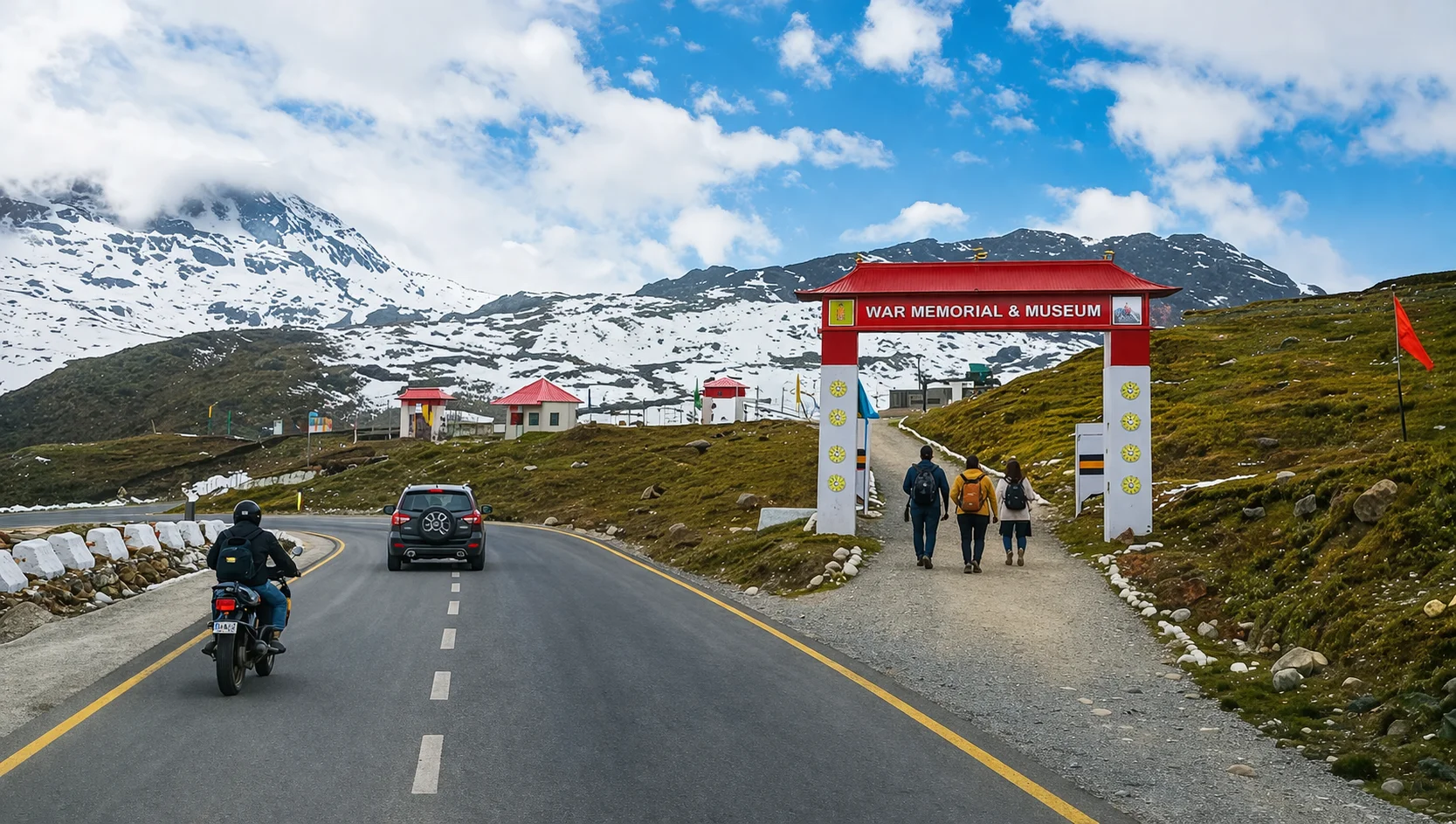
Engine Requirements
| Vehicle Type | Requirement | Notes |
|---|---|---|
| Cars (4‑wheelers) | 1400cc or higher | Strictly enforced. Private vehicles from outside Sikkim are generally not permitted; you’ll need to hire a local SUV. |
| Motorcycles | 1400cc+ | Special permission required. Riders must join a supervised convoy with army/police escort. |
Vehicle Caps
- Doklam: 25 vehicles + 25 bikes per day
- Cho‑La: 25 vehicles + 25 bikes per day
Road Conditions & Route
The route originates in Gangtok:
- Gangtok → Tsomgo (Changu) Lake (55 km, 2 hours)
- Tsomgo → Kupup → Zuluk (via Silk Route, 30 km, challenging)
- Kupup → Doklam (23 km into Chumbi Valley)
Kupup → Cho‑La (steep ascent to 17,780 ft)
The Border Roads Organisation (BRO) continuously upgrades these roads. In late 2025, a supercar rally successfully completed the circuit, demonstrating that while demanding, the infrastructure can handle high‑torque vehicles.
Best Time for Doklam & Cho-La Pass battlefield tourism
| Season | Conditions | Recommendation |
|---|---|---|
| Spring (Mar–May) | Rhododendrons in bloom, daytime temperatures 10–20°C at lower altitudes; sub‑zero at passes. Clear skies. | Best for photography and comfortable travel. |
| Autumn (Oct–Dec) | Post‑monsoon clarity, best views of Kanchenjunga and Tibetan plateau. Daytime pleasant, nights cold. | Ideal for visibility. Also coincides with local festivals. |
| Winter (Dec–Feb) | Snow‑covered landscapes, extreme cold (-10°C to -15°C at passes). Road closures common. | Only for well‑prepared adventurers. Carry heavy woolens. |
| Monsoon (Jun–Sep) | Heavy rainfall, landslides, frequent road blocks. | Avoid entirely. Risk of being stranded is high. |
High‑Altitude Safety Guide
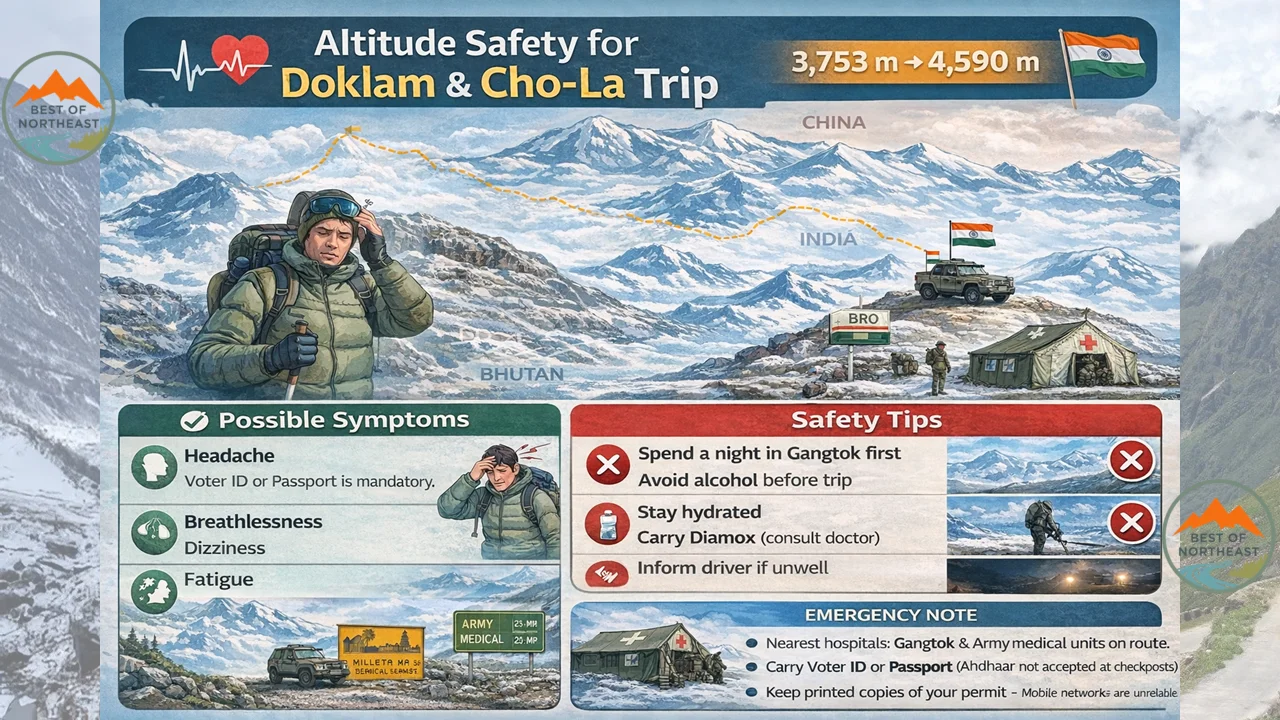
Cho‑La Pass sits at 17,780 feet – higher than Everest Base Camp. The body needs time to acclimatize.
Recommended Acclimatization Itinerary
| Location | Altitude | Stay |
|---|---|---|
| Gangtok | ~5,000 ft | 2 nights |
| Zuluk (homestay) | ~10,000 ft | 1 night |
| Kupup | ~13,000 ft | Day visit (no overnight) |
| Cho‑La / Doklam | 13,780 – 17,780 ft | Day visit, then return to lower altitude |
Acute Mountain Sickness (AMS) Symptoms
- Mild: Headache, nausea, dizziness, loss of appetite
- Moderate: Vomiting, worsening headache, fatigue
- Severe (HAPE/HACE): Breathlessness at rest, confusion, loss of coordination, blue lips – descend immediately
Prevention
- Hydrate: Drink 3–4 liters of water daily. Avoid alcohol and smoking.
- Carry a pulse oximeter: If oxygen saturation drops below 80% at Zuluk or Kupup, do not ascend further.
- Portable oxygen: Most tour operators provide oxygen cylinders for the final ascent to Cho‑La.
- Slow down: Walk slowly, avoid running or strenuous activity.
Army medical facilities are stationed at the 17th Mile and near Doklam base camp. They are equipped to handle emergencies, but descent is the only real cure for severe AMS.
What the Visitor Experience Feels Like
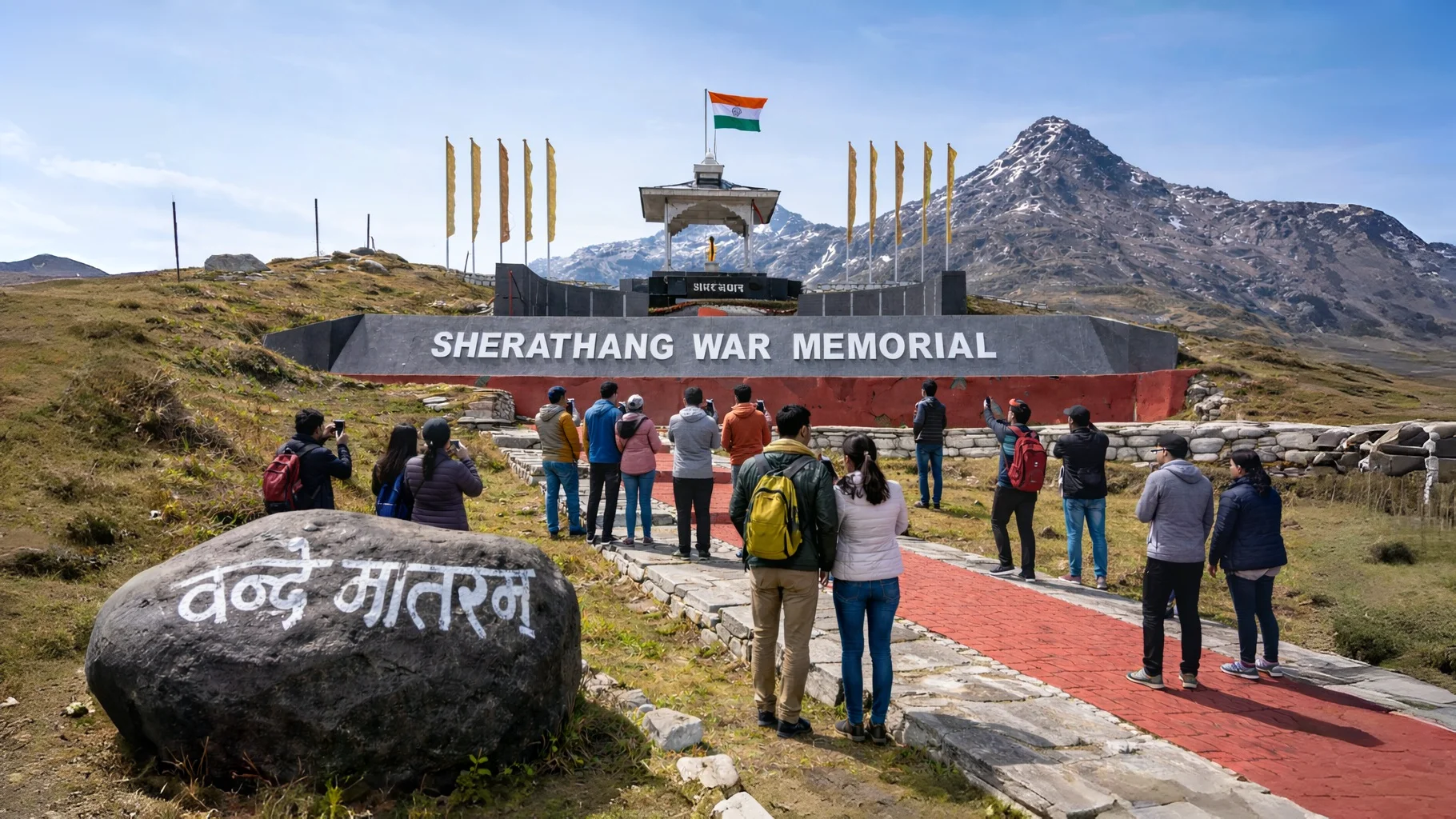
Doklam & Cho-La pass battlefield tourism is not a typical holiday. It is an emotional, patriotic journey that often leaves a lasting impression.
Meeting the Soldiers
One of the most cherished moments is interacting with the soldiers stationed at these remote outposts. They manage both border defense and tourist safety. Travelers often describe feeling immense gratitude after seeing the conditions in which our troops live. Do ask for permission before taking photos of personnel or military installations.
The Views
From the Doklam plateau, you can see the Chumbi Valley stretching into Tibet. From Cho‑La, the view of the Himalayan peaks is breathtaking. Many visitors remark on the “aerial visibility” – the ability to see Bhutan and the Tibetan plateau from Indian territory.
Patriotic Impact
“I came for the adventure, but left with a different understanding of what it means to guard the border,” is a common sentiment. The experience frequently reshapes visitors’ perspectives on national security.
Photography Rules
- Allowed: Scenery, civilian group photos, landscapes.
- Not allowed: Military installations, soldiers’ faces without consent, strategic infrastructure.
- Always ask: If unsure, a soldier or guide will clarify.
Cost Breakdown (2‑Day Battlefield Circuit)
| Item | Cost (per person, group of 4) | Notes |
|---|---|---|
| Permit Fee | ₹1,120 | Government PAP fee |
| Homestay (1 night) | ₹2,000 – ₹3,000 | Includes dinner & breakfast |
| Vehicle (2 days, private SUV) | ₹11,000 – ₹12,000 total | Shared among group = ₹2,750–₹3,000 per person |
| TPSS & Other Fees | ₹120 | Mandatory |
| Total Estimated (per person) | ₹5,500 – ₹7,000 | Excludes personal expenses & oxygen |
For solo travelers, shared jeep tours may be available at lower costs, but availability is limited due to the mandatory homestay and vehicle cap rules.
FAQs: Doklam & Cho-La Pass Battlefield Tourism
Can tourists visit India‑China border at Doklam?
Yes, Indian nationals can visit Doklam and Cho‑La pass under the regulated battlefield tourism program. Foreigners are not permitted.
Can foreigners experience Doklam Battlefield Tourism?
No. Both Doklam and Cho-La Pass are restricted to Indian nationals only.
Is Doklam safe to visit?
Yes. The area is under Indian Army control and tourism is tightly regulated. Safety protocols are in place, but travelers must adhere to altitude precautions.
Do bikes need a special permit?
Yes. Motorcycles require engine capacity of 1400cc or higher. Riders must join a supervised convoy.
Is there mobile network connectivity?
Network is unreliable. BSNL often works intermittently; other providers may not. Carry printed copies of permits.
What happens if the road closes due to weather?
Permits are date‑specific, and there are no refunds if roads close due to snow or landslides. Always build buffer days into your itinerary.
Can I drive my own private vehicle from Delhi or Kolkata?
Private vehicles registered outside Sikkim are generally not permitted for Doklam and Cho‑La pass. You must hire a local SUV through a registered tour operator.
Is there an age limit?
No official age limit, but the extreme altitude makes it unsuitable for children under 5 and seniors over 65 without medical clearance.
Conclusion
Doklam and Cho‑La Pass represent a new frontier in Indian tourism – one that blends military history, strategic geography, and high‑altitude adventure. The opening of these sites under Bharat Ranbhoomi Darshan offers Indian citizens a rare opportunity to stand where history was made and to appreciate the sacrifices of those who guard our borders.
Planning this trip requires patience, preparation, and respect for the rules. But for those who make the journey, the reward is an unforgettable experience that combines patriotic pride with raw Himalayan beauty.
Related Articles in This Series
- Article 1: The NEW Sikkim Permit System (2026): Step-by-Step Guide + Mistakes That Can Ruin Your Trip
- Article 3: Gangtok Shared Taxi & Transport Guide
- Article 4: Vegetarian & Vegan Food Guide
- Article 5: Solo Female Travel Ultimate Guide for Safety and More
Information is accurate as of April 2026. Permits, vehicle rules, and road conditions can change. Always confirm with your registered tour operator before travel.