
Last fact-checked: 20 November 2026. Permit arrangements and mountain-road access can change without notice. Reconfirm your route with a Sikkim-registered operator before paying for travel.
Quick Answer: Do You Need a Permit for Sikkim?
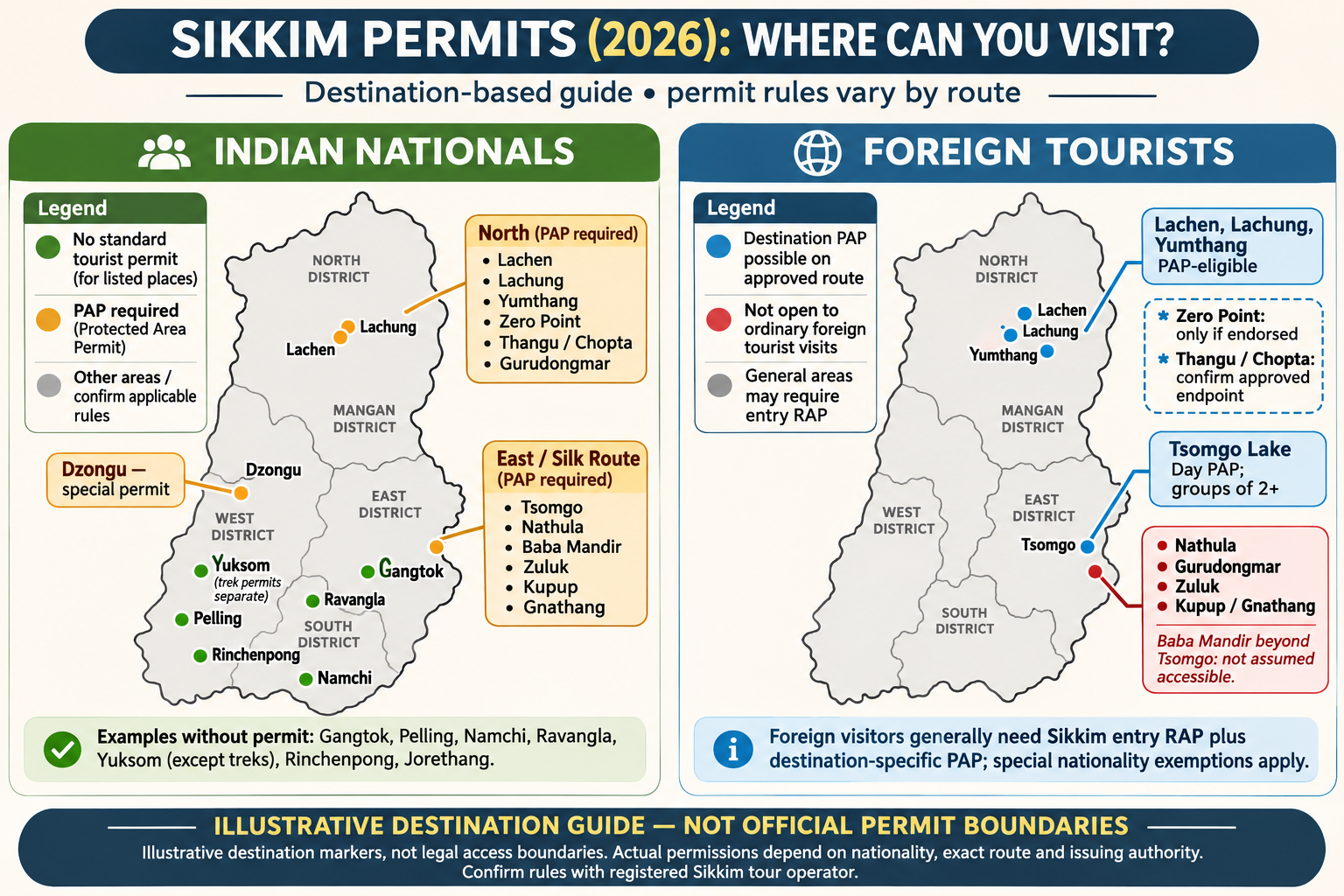
Indian citizens do not ordinarily need a permit to visit Gangtok, Pelling, Namchi or Ravangla.
They do need a Protected Area Permit (PAP) for destinations such as Tsomgo Lake, Nathula, Zuluk/Kupup, the protected North Sikkim routes and Dzongu. These permits are arranged through government-registered Sikkim tour operators and the designated issuing authorities; submit the required documents at least one working day ahead, and allow more time for busy dates.
Most foreign visitors need Sikkim entry clearance, often called a Restricted Area Permit (RAP), although current Sikkim Tourism material also calls it PAP/ILP. People of Bhutanese origin are exempt from the ordinary RAP requirement; Nepalese visitors have special identity-document rules. Other visitors should check their nationality-specific requirements. The authorised ordinary application routes are an Indian Mission before travel or e-FRRO after arrival in India; designated IVFRT counters handle qualifying emergencies only. Visitors who also want protected places such as Tsomgo or permitted North Sikkim sectors need separate destination-specific PAP clearance through a registered Sikkim operator.
Do not rely on a claim that every permit is now a QR-coded permit.
In August 2026 the state announced a proposed integrated online system, but its full rollout has not been verified. Certain PAP applications are already processed online through existing government arrangements; that is not the same as the proposed new platform.
Table of Contents
Who Needs a Permit?
Sikkim travel permit rules summarized in a simple table.
| Traveller and destination | Permit / clearance | How to arrange it |
| Indian citizen: Gangtok, Pelling, Namchi, Ravangla | No standard tourist entry permit | Travel with normal identification |
| Indian citizen: Tsomgo Lake, Nathula, Zuluk, Kupup | PAP | Registered Sikkim operator and designated issuing authority |
| Indian citizen: Lachen, Lachung, Yumthang, Gurudongmar | PAP | Registered Sikkim operator; route and road access must be approved |
| Indian citizen: Dzongu | Special PAP / local protected-area permission | Registered operator / appropriate district authority |
| Foreign national (subject to RAP exemptions): entering Sikkim | Entry RAP/PAP (government labels vary) | Indian Mission before travel, e-FRRO after arrival, or emergency-only IVFRT counter; Bhutanese-origin exemption and Nepalese documentation rules apply |
| Foreign national: Tsomgo Lake | Additional destination PAP | Sikkim-registered operator; approved one-day excursion; at least two foreign visitors |
| Foreign national: permitted North Sikkim valleys | Additional destination PAP | Registered Sikkim operator and certified guide; group of two or more; approved 3–5-day itinerary |
| Foreign national: Nathula, Gurudongmar Lake or Zuluk | Tourist access not permitted | Do not book these as foreign-national excursions |
| Traveller: protected-area trekking route | Route-specific permit, possibly other clearances | Registered trekking agency and competent issuing office |
Why Does Sikkim Require Permits?
Sikkim shares international borders with China (Tibet), Bhutan, and Nepal.
Large parts of North and East Sikkim are classified as Protected Areas.
Sikkim Permits exist for:
• National security (border monitoring)
• Environmental protection (fragile Himalayan ecosystems)
• Traveler safety (extreme altitude & weather risks)
The Sikkim Permit (2026): What Changed?
| Topic | Current arrangements in official guidance | Proposed integrated system (announced August 2026; rollout not verified as of 11 November) |
| Who submits protected-route applications? | Registered Sikkim tour operators / travel agencies work with the relevant tourism or police issuing offices | Applications continue through authorised Sikkim-registered agencies, each with traceable credentials |
| Existing digital processing | Some route permits already processed online through the 3rd Mile Police Checkpost and registered operators | An integrated government-controlled digital workflow across notified PAP/RAP routes |
| Foreign visitor entry clearance | Indian Missions, e-FRRO or emergency-only IVFRT counters, subject to the visitor’s circumstances | Separate legal/security requirements for foreigners would continue to apply |
| Documents/checkpoints | Permits may be issued or carried as printed/endorsed records or electronic approvals; checkpoints verify authorisation | Digital tracking, payments and monitoring proposed |
| Timing | Indian PAP paperwork should be submitted at least a day in advance; e-FRRO entry applications take longer (Sikkim Tourism quotes 3–4 days minimum, up to 15 working days) | No verified universal one-day or one-week guarantee |
| Changes and refunds | Depend on the issuing authority and the operator’s terms | Modification, cancellation and refunds were proposed; not verified as implemented benefits |
Bottom line: The August announcement was a proposal, not proof that manual permits ended or QR scanning became compulsory at every checkpost. Ask your operator exactly what permit or pass will be issued for your approved route.
Which Destinations Require Permits?
North Sikkim: Which Places Need a PAP?
| Destination | Indian tourists | Foreign tourists | Important limit |
| Lachen | PAP required | PAP-eligible | Exact route, accommodation and vehicle approval still required |
| Lachung | PAP required | PAP-eligible | Base for approved Yumthang excursions |
| Yumthang Valley | PAP required | PAP-eligible | Weather and route restrictions can change |
| Yumesamdong / Zero Point | PAP required | PAP-eligible where specifically endorsed | Do not assume that a general Yumthang permit extends to Zero Point |
| Thangu / Chopta Valley | PAP required | The government lists the Thangu–Chopta sector, but other instructions describe foreign clearance up to Thangu | Confirm the exact approved endpoint in writing |
| Gurudongmar Lake | PAP required | Not permitted for foreign tourists | Foreign permits on this axis stop before the lake |
Foreign-national timing: Government guidance provides a minimum three-day and maximum five-day PAP for approved Lachen/Lachung/Yumthang/Yumesamdong/Thangu trips. This does not establish a universal three-day minimum for Indian tourists.
Permit format: Do not reject a permit merely because your operator provides an endorsed or printed copy. Foreign visitor e-FRRO clearance may arrive electronically, while emergency IVFRT counters can issue validated physical slips. Carry the original identification document and copies of the permissions relevant to your journey.
East Sikkim and the Old Silk Route: Permit Rules
| Destination | Indian tourists | Foreign tourists | Important note |
| Tsomgo (Changu) Lake | PAP required | One-day destination PAP allowed for foreign groups of at least two (S12) | Permit via registered agency; not authorisation to continue to Nathula |
| Nathula Pass | PAP required | Not permitted | Closed Mondays; official sources disagree on some other operating days |
| Baba Mandir beyond Tsomgo | PAP required | Do not assume access beyond the approved Tsomgo endpoint | Check the route shown on the foreign permit |
| Zuluk (Dzuluk) | PAP required | Not permitted | Old Silk Route; restricted defence border zone |
| Kupup / Gnathang | PAP required | Not permitted (not on the foreign-tourist list) | Restricted Old Silk Route sector |
Nathula days: The Government of Sikkim General Info page says Nathula permits are issued Tuesday to Sunday and that the pass is closed on Mondays. The Sikkim Tourism Development Corporation lists four days (Wednesday, Thursday, Saturday and Sunday), and many operators quote Wednesday to Sunday. Monday closure is consistent in the official sources. Ask the registered operator to confirm the actual operating and permit day before you buy a package, and do not assume Tuesday or Friday access.
No Permit Required (Indians)
Indians visitors do not need a permit under the Sikkim permit guide, last verified on 11 November 2026.
• Gangtok
• Pelling
• Namchi
• Ravangla
• Yuksom (except treks)
• Rinchenpong
• Jorethang
Five Permit Mistakes That Can Disrupt a Sikkim Trip
1. Assuming a foreign visitor can obtain routine entry clearance at Rangpo.
Foreign travellers should ordinarily arrange Sikkim entry clearance through an Indian Mission before travelling or through e-FRRO after arriving in India. The designated IVFRT counters are reserved for emergency cases, not a dependable walk-in option. Indian visitors can arrange their protected-route PAP through a registered operator after reaching Gangtok, provided they allow time for processing.
2. Leaving the application until the morning of the excursion.
For Indian PAPs, the government specifies submission at least a day before travel, subject to scrutiny and approval. Sending documents 5–7 days ahead in busy periods is a sensible precaution, not an official guaranteed processing time. Foreign visitors using e-FRRO should plan much earlier: Sikkim Tourism reports roughly 3–4 days minimum and potentially up to 15 working days (e-FRRO’s own general advice is to apply at least two weeks before you need a service).
3. Carrying Aadhaar as the only nationality proof.
Government PAP instructions say Aadhaar is not accepted as proof of nationality. Indian visitors should bring an original passport, Voter ID, Indian driving licence or other specifically eligible central/state government-issued ID, plus two photographs and copies as requested. For minors, the government’s document list includes a birth certificate. Foreign nationals need the required passport, visa and entry/destination permissions.
4. Treating one permit as permission for every border route.
A Tsomgo excursion does not give a foreign visitor access to Nathula. A Yumthang permit does not automatically authorise Yumesamdong/Zero Point. Ask the operator to show the permitted destinations, dates, traveller names and vehicle details.
5. Assuming a road closure will automatically trigger a refund.
Rain, snow, landslides and security restrictions can stop travel even after a permit is issued. Refund, rescheduling and cancellation terms depend on the operator and the issuing rules in force. Before payment, ask what happens if a road is closed or a permit is not granted. The government’s proposed integrated system mentioned future refund provisions, but these are not verified as operational.
Reality Check: Permits Shape Your Itinerary
Permit approval determines which protected routes you can visit, but the rules are not identical for everyone. A foreign-national PAP for the notified Lachen–Lachung–Yumthang–Yumesamdong–Thangu sectors is valid for an approved 3–5-day itinerary; that duration must not be copied into the rules for all Indian travellers.
Before booking, ask your Sikkim-registered operator for:
- (1) the precise permitted route and departure date
- (2) whether the quoted price is per person or for the entire vehicle
- (3) the government fee versus the operator’s processing/transport charge
- (4) accommodation and meal inclusions
- (5) cancellation or road-closure terms
A package price is not the same as a permit fee. Do not assume that paying for a tour guarantees permission, a particular high-altitude destination, or an open road.
How Early Should You Plan for Your Sikkim Trip
| When | Indian traveller visiting protected routes | Foreign traveller |
| 2–4 weeks before a busy-season trip | Choose routes, check road season, compare registered operators and booking terms | Check nationality-specific restrictions and which entry-clearance channel you can use |
| Before you fly to India, if possible | — | Ask the Indian Mission to endorse Sikkim entry permission when you apply for your Indian visa. This avoids waiting for e-FRRO approval after you land. |
| As soon as you land, if using e-FRRO | — | e-FRRO is available only after arrival in India, so apply immediately. Sikkim Tourism quotes 3–4 days minimum and up to 15 working days; e-FRRO’s general advice is to apply at least two weeks before you need a service. |
| About 5–7 days before a busy-season excursion | Send accepted IDs, two photographs and route details to the operator as a precaution | Arrange the separate destination PAP with a registered operator if visiting Tsomgo or approved northern sectors |
| At least one working day before the protected excursion | Have the operator submit the route-specific PAP documents; issuance remains subject to approval | Check that entry clearance, destination PAP and tour arrangements all match |
| Travel day | Carry original accepted ID, copies of the approved permit, and operator contact details | Carry original passport, visa, entry clearance and destination PAP (if applicable) |
Planning recommendation, not a guarantee: These intervals combine government minimums with practical buffer time. Submission does not guarantee approval or road access.
How Indian Citizens Apply for a Sikkim PAP
Step 1: Choose a Sikkim-registered operator.
Tell the operator your nationality, dates, full list of destinations and whether you will travel by approved taxi or eligible motorcycle. PAPs for the main tourist protected routes are processed by designated authorities through registered local travel agencies. Ask for an itemised quote separating government charges from operator service and vehicle costs.
Step 2: Supply the correct documents.
Government guidance lists an Indian passport, Voter ID, Indian driving licence or other eligible central/state government-issued nationality proof; Aadhaar is not accepted as nationality proof for PAP processing. Keep the original ID and copies, two passport-size photographs, and a birth certificate for a minor. If bringing an eligible motorcycle, add the RC, driving licence, insurance, PUC and relevant rental or ownership documents.
Step 3: Allow time for checking and approval.
The government accepts Indian PAP applications at least a day before travel, subject to verification and scrutiny. Submit earlier in busy periods. An agency’s booking confirmation is not itself a PAP.
Step 4: Check the issued documents.
Confirm names, travel dates, vehicle registration and authorised route. Carry printed copies and digital backups because network service can be unreliable in high-altitude areas. Some permits are processed online; this is not evidence that every traveller will receive the proposed new QR-coded permit.
How Foreign Nationals Obtain Sikkim Entry Clearance and Destination PAPs
First understand the two permissions. For entry, the Government of Sikkim traditionally calls the foreign visitor permit a Restricted Area Permit (RAP), also called ILP. Newer Sikkim Tourism guidance sometimes calls this entry clearance PAP/RAP. A separate destination PAP is needed to visit authorised protected areas such as Tsomgo Lake or permitted North Sikkim sectors.
Step 1: Obtain Sikkim entry clearance through an authorised channel.
- Before arriving in India: Ask the relevant Indian Embassy, High Commission or Consulate about a Sikkim permit endorsement when applying for your Indian visa.
- After arriving in India: Apply yourself through the official e-FRRO portal, upload the required documents and pay any fee notified by the portal. Sikkim Tourism quotes approximately ₹2,880 per person and an indicative processing period of 3–4 days minimum, potentially up to 15 working days. e-FRRO’s general guidance is to apply at least two weeks ahead of need. Neither the fee nor the completion date should be treated as a guarantee.
- Emergency only: Designated IVFRT facilitation counters can process qualifying exceptional cases, with a validated physical permit slip. Do not plan to obtain an ordinary walk-in permit at Rangpo, Melli or an airport.
Step 2: Prepare documents and check special nationality rules.
Sikkim Tourism lists a passport valid for at least six months, a valid Indian visa/e-Visa, recent passport-size photographs and port-of-arrival/departure details. OCI holders are treated as foreign nationals for Sikkim entry permits. Nepalese and Bhutanese visitors have special identity/exemption rules. Some nationalities or origins require prior MHA clearance; lists differ among government pages, so affected travellers should confirm with an Indian Mission before booking.
Step 3: Arrange additional permits for protected destinations.
If your itinerary includes Tsomgo or an approved North Sikkim valley, ask a registered Sikkim operator to organise the destination PAP, authorised vehicle and (where required) certified guide. Official Gangtok district guidance requires at least two foreign tourists for Tsomgo Lake; Sikkim Tourism likewise describes groups of two or more foreign tourists for protected northern circuits. Tsomgo permits are for one-day excursions; specified northern-sector permits are for 3–5 days. Foreign tourists are not permitted on ordinary tourist PAPs to Nathula, Gurudongmar Lake, Zuluk or the Kupup/Gnathang route. Yumesamdong and the Thangu/Chopta sector require the exact approved endpoint to be checked.
On arrival and departure: Sikkim Tourism’s RAP page instructs foreign visitors to register with the relevant Foreigners Registration Office within 24 hours of arrival and have their departure recorded. Ask the operator or FRO how this applies to your entry-clearance type and travel arrangement. Do not pay a middleman promising expedited e-FRRO approval: the official portal says applicants should submit their own application.
Motorcycle Permits: Ownership, Rentals and Documents
Sikkim Tourism states that motorcycles entering protected-area routes must be 150cc or above, with valid fitness and insurance documents. The Government of Sikkim describes two recognised cases: personally registered/self-driven motorcycles, and rental motorcycles hired within Sikkim. Both require route-specific permission through a government-registered Sikkim operator, with paperwork submitted at least one day before travel and the prescribed bike fee paid by bank receipt at the State Bank of Sikkim. A two-wheeler pass is issued for up to seven days. A Sikkim-registered private bike is not automatically exempt from the PAP requirement, although the permit fee is exempted; a bank receipt is still required for Nathula, and Nathula bike permits are issued Tuesday to Sunday only (Monday is closed).
Ask the operator to check the RC and registration state, your driving licence, insurance, PUC, rider/pillion IDs, photographs and, for a Sikkim rental, its lawful rental agreement. Do not assume that a borrowed bike in a relative’s name or an out-of-state rental qualifies. The government has discussed tighter restrictions on outside-registered vehicles under a proposed system; this proposal should not be rewritten as a blanket ban already enacted.
Foreign riders face additional conditions: the government’s PAP guidance refers to an international driving licence, registered operator, certified guide and escort vehicle for protected routes, with passes limited to Tsomgo Lake for one day or the northern valleys for a maximum of five days. Their permitted routes remain narrower than the routes open to Indian citizens.
Cost of Sikkim Permit for Bikers: There is no sufficiently verified, universally current government rate table in the supplied primary sources. Ask for an itemised current quotation, the government receipt and the exact number of travel days.
Cars and Taxis on Protected Routes
Travel to Tsomgo, Nathula, the Old Silk Route and North Sikkim must follow the route and vehicle conditions on the issued permit. Sikkim Tourism requires protected-area tours to be routed through government-registered travel agencies or tour operators, with vehicle permits issued by the Police Check Post. Registered local operators arrange the authorisations and suitable vehicles. Do not assume that an out-of-state self-drive car or a private vehicle can enter any protected route, and request written confirmation of vehicle eligibility before paying. A four-wheel-drive vehicle may be prudent for difficult conditions, but 4WD alone does not grant access.
Taxi tariffs: Sikkim’s Transport Department publishes notified local taxi hire tariffs under Government Gazette No. 331 of 14 August 2025. The Gazette says fares are dynamic and may vary with season and market demand as determined by the authority; it specifically states that lean-season fares may be up to 30% below notified fares. It provides a 50% increase for local tours between 10 PM and 4 AM and says a convenience fee of up to 15% may be applied to bookings via the Sikkim Cab app.
Doklam/Doka-La and Cho-La are a separate, more tightly regulated battlefield-tourism circuit. A September 2025 report quoting the Sikkim Home Department’s notification describes Indian-only access, registered-operator vehicles of at least 1400cc, and no private vehicles, along with designated escort and overnight-stay requirements. These are historical reported terms; confirm they still apply on your chosen dates and consult our dedicated Doklam/Cho-La guide for a fuller explanation.Do not confuse the cost of a vehicle, a sightseeing package and a government permit fee. Ask for a current itemised quote.
Sikkim Permit Costs: What Is Confirmed?
| Item | What to budget for / how to verify |
| Indian PAP for Nathula | Contemporary August 2026 reporting on the Chief Minister’s discussions cited ₹200 per tourist as the long-standing Nathula permit charge and discussed a possible revision. We have not verified a newer official charge schedule or whether a revised amount took effect. Confirm the current government charge and request a receipt before paying. |
| Indian PAP for Tsomgo / North Sikkim | Varies by issuing route and applicable charge; separate the government amount from the operator’s processing, taxi or package fee. Do not assume one universal ₹200–₹500 PAP tariff. |
| Foreign visitor entry clearance via e-FRRO | Sikkim Tourism quotes approximately ₹2,880 per person and a processing period of 3–4 days minimum, up to 15 working days; the actual portal instruction and payment notification control. |
| Foreign visitor entry permit at an emergency IVFRT counter | Official guidance states free, but these counters are for qualifying emergency cases only. |
| Motorcycle permission | Depends on bike registration, route and applicable government/operator charges; obtain an itemised written quote and receipt. |
| Taxi / vehicle hire | Government Gazette No. 331 (14 August 2025) specifies local taxi hire tariffs and says authority-determined fares are dynamic; it expressly mentions lean-season charges up to 30% below the notified tariff. It does not set a universal permit or shared-seat fare. Confirm the current authorised taxi hire amount separately from permit and operator charges. |
| Protected-area trekking permits | Route-specific; confirm fees and departmental approvals with the registered trekking agency. |
| Doklam / Cho-La battlefield excursion | Reported September 2025 rules stated ₹1,120 per person in permit-related charges and ₹11,000–₹12,000 for specified two-day vehicle packages. These are historical reported terms—not a verified current quotation. Reconfirm before using them to budget. |
Price check: A tour package may include the vehicle, driver, accommodation, guide, meals and permit processing.
Why Sikkim Travel Permit Rules Can Feel Complicated
Independent travellers often find that protected routes need more preparation than an ordinary hill-station trip. The main frustrations are: arranging a registered operator, selecting exact destinations and dates, checking vehicle eligibility, and adapting to weather or security closures. For foreign tourists, entry clearance and the additional protected-area PAP are separate tasks.
What the proposed integrated system aims to improve: The state outlined a consolidated, traceable agency-based application framework in August 2026, with digital payments and proposed cancellation/modification/refund provisions. These are proposed features, not benefits we have verified as operational.
What you can do now: Ask for a written route, document checklist, government versus agency fees, cancellation terms and a copy of the issued permit before setting out.
North Sikkim Road Connectivity: Mangan District Bulletin of 28 October 2026
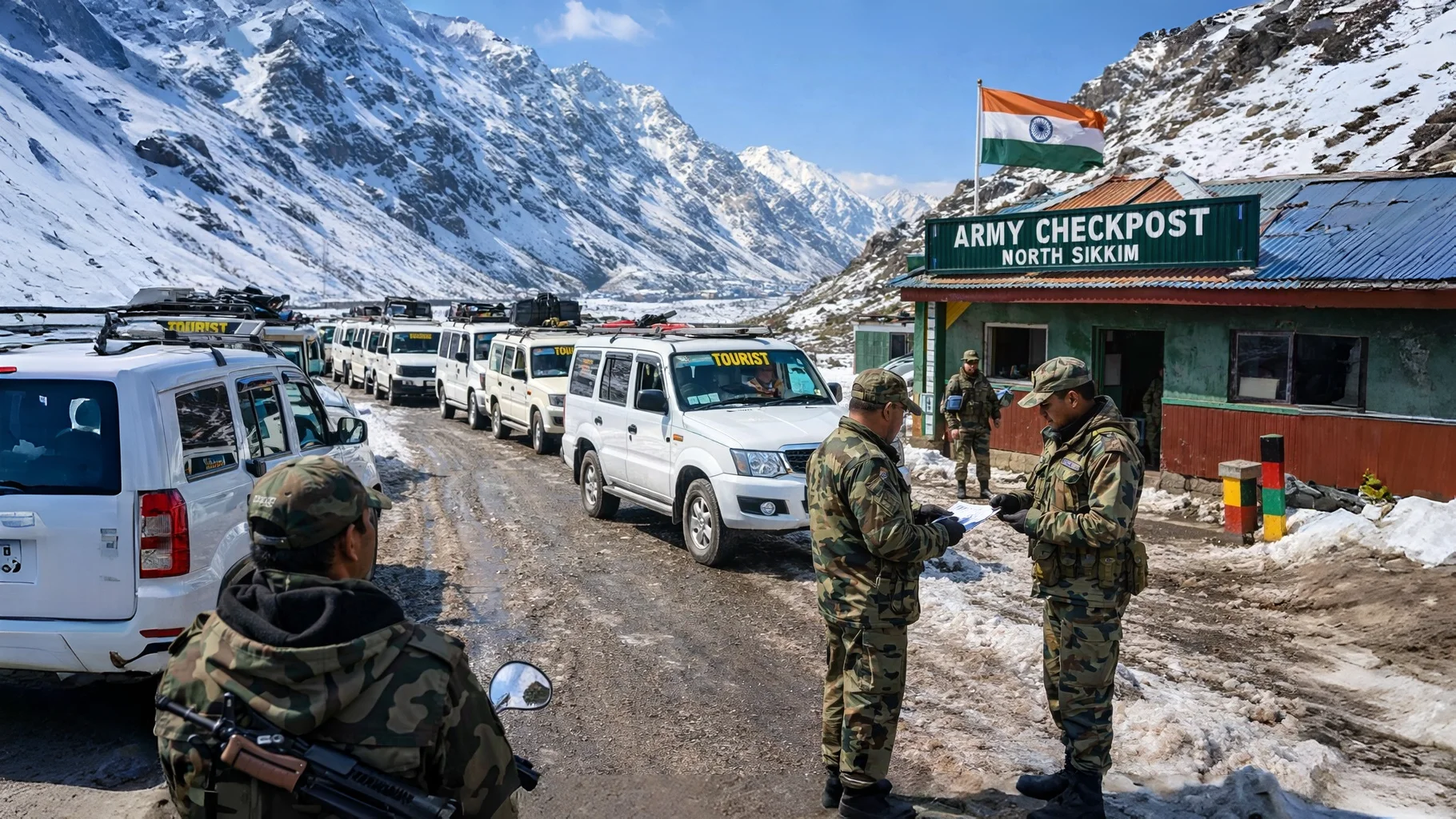
The 28 October 2026 bulletin from the Mangan District Administration reported the following conditions: Mangan–Chungthang via Toong Naga clear; Chungthang–Lachen clear for light vehicles only; Lachen–Thangu and Thangu–Gurudongmar clear; Chungthang–Lachung, Lachung–Yumthang and Yumthang–Zero Point clear.
Toong Check Post timing: Under a Mangan district order of 10 September 2026, as reported by the media, tourist and other light vehicles travelling between Gangtok/Mangan and Lachen/Lachung must cross the Toong Check Post by 4 PM in both directions. We have not seen a notice withdrawing it; confirm the current deadline with your operator before you plan transfers.
This is a dated road-status report, not a live guarantee of tourist access or permit approval. Landslides, snowfall, military requirements and vehicle restrictions can change the situation quickly. Check a more recent district bulletin and confirm the actual itinerary with the registered operator just before departure.
Frequently Asked Questions About Sikkim Travel Permit Rules
Can Indian travellers arrange a PAP after reaching Gangtok?
Yes, if there is enough time for processing. Protected-route PAPs are arranged through registered operators and designated authorities; the government requires applications at least a day ahead and approval is not guaranteed. Foreign visitors should arrange their entry clearance through an Indian Mission or e-FRRO instead of relying on routine border-counter issuance.
How far ahead should I apply?
For an Indian protected-area excursion, submit the documents at least one working day ahead and preferably earlier in busy periods. Foreign visitors using e-FRRO should plan for 3–4 days at minimum and potentially up to 15 working days (e-FRRO’s general advice is to apply at least two weeks ahead). Destination-specific PAPs require additional arrangements.
Is Aadhaar accepted for a Sikkim PAP?
No, not as the nationality proof required for the PAP application. Government guidance lists an Indian passport, Voter ID, Indian driving licence or another eligible central/state government-issued nationality document. Bring the original and copies.
Which days is Nathula open? Which days is Nathula closed?
Nathula is closed on Mondays. Official sources differ on other days: the Government of Sikkim says permits run Tuesday to Sunday, while the Sikkim Tourism Development Corporation lists Wednesday, Thursday, Saturday and Sunday. Ask your registered operator to confirm the permit day before you pay.
Can a foreign tourist visit Tsomgo Lake alone?
Government of Sikkim district guidance states that foreign visitors need a minimum group of two for Tsomgo Lake and must apply for the visit permit through a registered agency. A solo visitor should ask whether joining an authorised group is possible; do not assume an individual Tsomgo permit will be issued.
Can foreigners visit Nathula or Gurudongmar Lake?
No, not on ordinary foreign-tourist PAPs. Foreign tourists may apply for Tsomgo and specified northern valleys, but the approved endpoint matters. For Thangu/Chopta and Yumesamdong, confirm the exact destinations on the issued permit.
Can foreigners visit Lachen or Zero Point?
They are listed among permit-eligible destinations, subject to the government’s approved route, registered operator, required group arrangements and current operational access. A general Sikkim entry permit alone is insufficient.
Do children need separate documents?
The Government of Sikkim lists a birth certificate for minors in Indian PAP applications, alongside supporting family identification as required by the issuing office. Check age-specific documentation and medical suitability with the operator before booking high-altitude travel.
Can I take a rental motorbike?
A motorcycle hired inside Sikkim may be eligible if it meets the 150cc minimum and other permit, registration, insurance and rental-document rules. The government separately recognises personally registered bikes. Do not assume an out-of-state rental or borrowed bike qualifies; have the registered operator verify the exact vehicle first.
What happens if I arrive without the required permit?
You may be refused entry at the relevant checkpoint. For foreign visitors, emergency-only IVFRT processing is not a dependable replacement for advance entry clearance.
Is the 2026 integrated QR-code permit system live?
The government announced a proposed integrated system in August 2026. We have not verified a subsequent government commencement notice confirming full rollout. Some PAPs already undergo online processing through existing official systems; that is not proof of the proposed scheme being operational.
Are permits or tour fees refundable if a road closes?
There is no universal refund promise established by the sources reviewed. Ask the operator for written cancellation terms and confirm applicable permit rules before booking. The state’s proposed platform mentioned future refund provisions, which should not be advertised as a current entitlement.
Final Advice Before You Travel
Sikkim’s protected-area permits reward planning, but the correct process depends on nationality, route and vehicle. Indian tourists should organise their destination PAP through a registered Sikkim operator and carry accepted original identification. Foreign tourists should first arrange Sikkim entry clearance through an authorised channel, then obtain additional approval for any protected destinations they intend to visit.
Your final check: approved destinations and dates, documents, vehicle registration, current road conditions, itemised charges and cancellation terms. Keep printed copies of permissions and digital backups, and verify operational changes close to departure.
Continue Planning Your Sikkim Trip
- Doklam and Cho-La battlefield tourism guide
- Gangtok shared taxi, bus and self-drive guide
- Solo female travel in Northeast India
- Sikkim vegetarian and vegan food guide
Official sources last reviewed: 11 November 2026.