


Most Majuli guides start with the sights. We’d start with the ferry, because the ferry decides whether a day trip works at all. The district administration says ferries between Jorhat and Majuli run from 7:30 AM to 3:30 PM, so everything you do on the island has to fit inside that window. And the service is more fragile than most guides admit. It has stopped or changed ghats in low water, high water and fog, including for three months in the 2025 to 2026 dry season.
This guide works out what a Jorhat to Majuli day trip could realistically give you, explains which routes and ghats matter, and says what to do when ferry plans change. It draws on official pages, dated news reports and published trip guides. We haven’t made the crossing ourselves. Published times are reported ranges, not a current schedule, and every calculation here is a conditional example, not a confirmed daily departure.
Jorhat to Majuli at a Glance
- Routes: ferries run from Nimati Ghat (Jorhat) to Kamalabari Ghat or Afalamukh Ghat (Majuli), and back, according to the Majuli district administration.
- Hours: the district’s directions page says ferries run from 7:30 AM to 3:30 PM for Jorhat to Majuli. Its main page describes the half-hourly service on that window specifically for festival season. A March 2026 report said services returning to Kamalabari would run at hourly intervals, and an older Assam Tourism brochure says hourly sailings from 8 AM to 4 PM. Treat these as reported ranges, not a timetable.
- Night sailings: these fall outside the official window. The Times of India reported a night ferry resuming on 12 December 2024 after a six-month halt, and suspended indefinitely on 30 December 2024 because of silt. We haven’t found confirmation that night sailings are running now, so don’t plan around one.
- Tickets: the district recommends booking passengers and vehicles in advance on the Assam Inland Water Transport portal. Its helpline for Jorhat and Majuli is 1800 889 4717.
- Getting to the ghat: trip guides put Nimati Ghat about 14 km from Jorhat, and the crossing at 1 to 1.5 hours (trip guide, May 2025). These aren’t official figures.
- Fare: an older Assam Tribune listing gives ₹15 per head from Nimati to Kamalabari. Check the portal for current fares.
- Bridge: a Jorhat to Majuli bridge is under construction but not open. Plan around the ferry.
Official pages checked on 7 November 2026. We couldn’t find a current notice for the route, so check the portal and helpline before you travel.
Know Your Route: Kamalabari, Afalamukh and Your Direction

Majuli has two ferry ghats for Jorhat services, and they fail in different ways. Which one is working decides your timing, so ask.
Nimati to Kamalabari is the route most trip guides describe. It’s also the one low water has closed most often: in October 2024, in early 2024, and for three months in the 2025 to 2026 dry season.
Nimati to Afalamukh has kept running when Kamalabari closed, but with limited capacity. In October 2024 an IWT engineer said the passenger load there had increased manifold, creating a chaotic situation, and schedules were changed to cope. It has also been the one suspended while Kamalabari reopened, after the July 2024 high water.
Ro-Pax and smaller boats: the larger Ro-Pax vessels can’t run in shallow water, which is why only smaller marine-engine boats resumed in October 2024. In July 2026, the Ro-Pax service stopped first when the river rose.
Direction: the return crossing is a separate booking and a separate risk. A day trip depends on the last sailing back, so confirm it for both directions, not just the morning crossing.
Recent Disruptions, Newest First
These are the cases we could find in news reports. They aren’t a complete list.
- 19 to 20 July 2026, flood: the Ro-Pax service stopped on Sunday. On Monday all services were suspended indefinitely after the ramps at both Kamalabari and Afalamukh were submerged (report). We found no report of when services resumed.
- December 2025 to 21 March 2026, low water: operations shifted near Afalamukh for three months, then returned to Kamalabari with sailings at one-hour intervals (Pratidin Time).
- June 2025, high water: services resumed after a three-day halt, but only passengers and two-wheelers were allowed because of strong currents (India TV). If you’re travelling with a car, ask.
- 2024: fog and falling water caused cancellations in January (India Today NE), and larger ferries returned to Kamalabari in April after a three-month gap (PTI via ETV Bharat). In late June, high water halted services for six days, and Afalamukh stayed suspended after Kamalabari resumed on 5 July (Assam Tribune, Sentinel). From 20 to 30 October, low water stopped the Kamalabari route, which resumed with smaller boats after dredging. Depth had fallen to 1 to 2 feet in places against a required 4 to 6 (Sentinel, India Seatrade). Afalamukh was crowded in the meantime (India Seatrade), and the transport minister pressed to restore the service before Raas (Hills Times).
- 19 June 2023, fog: a ferry carrying 134 passengers was stranded in dense fog and rescued by SDRF personnel, and services were suspended in the foggy conditions.
The pattern in what we found: low water has disrupted the Kamalabari route in each of the last three dry seasons (2023 to 2024, 2024 to 2025 and 2025 to 2026), and high water can close both ghats in the monsoon. We haven’t checked every season, so treat this as a pattern in the reports we found, not a statistic. It also means October to March, the usual best time for the island, isn’t a guarantee for the crossing. A Sentinel editorial in October 2024 said dry-season suspensions had become more frequent.
The bridge isn’t open yet
Construction of the Jorhat to Majuli bridge resumed in January 2026 under a new contractor, and a June 2026 report describes it as still under construction. The earlier contractor left the work incomplete after September 2024, and the retender set a two-year completion target from the new contractor’s appointment. For trips in the next year or so, assume the ferry.
The Jorhat to Majuli Day-Trip Arithmetic.
These are conditional examples. They assume a sailing exists at the times shown, which you must confirm. Work back from the last sailing, and swap in your own assumptions:
- Last sailing: 3:30 PM, the official window. Some sources say 4 PM, but we wouldn’t rely on that.
- Buffer at the ghat: be there 30 minutes before the sailing.
- Transfers on the island: 30 minutes each way between the ghat and your first and last stops.
- Crossing: 1 to 1.5 hours.
- Jorhat to Nimati Ghat: about 40 minutes, including finding transport.
On those assumptions, three versions of the day look like this:
- A 7:30 sailing, 1-hour crossing: leave Jorhat by about 6:15 AM and reach the ghat around 6:55, about 35 minutes before a 7:30 sailing. Follow the boarding time on your ticket or the ghat staff’s instructions, because the actual arrangements may differ. You reach Kamalabari about 8:30, and your first stop starts about 9:00. To catch the 3:30 PM sailing you must leave your final stop by 2:30 PM. That’s about 5.5 hours on the island.
- The same sailing, 1.5-hour crossing: you arrive about 9:00 and start about 9:30, which leaves about 5 hours.
- You miss it and take the 8:30: with a 1.5-hour crossing, you start about 10:30, which leaves about 4 hours. If sailings are hourly, as reported in March 2026, a missed boat costs you a full hour.
Take out an hour for lunch and the walking and waiting between stops, and a day trip gives you roughly three to four and a half hours of sightseeing. A 3:30 PM sailing with a 1 to 1.5 hour crossing reaches Nimati Ghat between about 4:30 and 5:00 PM, and Jorhat around 5:15 to 5:45 PM. So don’t book anything tight for that evening. If services are running from the alternative ghat, the transfer to your first stop changes, and we don’t have a reliable figure. Ask before you set out.
What those hours could look like
Majuli’s satras are working Vaishnavite monasteries spread across the island. The Government of Assam’s tourism portal says the ones best set up for visitors include Natun Kamalabari, Uttar Kamalabari, Auniati, Bhogpur and Dakhinpat, and that the first two are within walking distance of Kamalabari (Assam government). A local tour operator’s site puts Auniati roughly 5 km west of Kamalabari, Natun Chamaguri (known for mask-making) about 12 km east, and Dakhinpat about 20 km away at the south-eastern end (Majuli Tourism). Distances vary between sources, so ask your driver. Two illustrative plans for the 9:00 to 2:30 window:
- A satra day: Uttar Kamalabari Satra first (about 9:00 to 10:15), then Auniati Satra and its museum (about 10:30 to noon, including the drive), lunch (about 12:15 to 1:15), and the rest of the time in the Kamalabari area, including the Tourist Information Centre at Kamalabari Ghat.
- A craft day: Uttar Kamalabari Satra (about 9:00 to 10:00), a drive east to see mask-making at Natun Chamaguri (about 10:40 to noon), lunch nearby, and a return to the ghat area by about 2:00 PM.
Both leave out Garamur, Dakhinpat and most of the island. Dakhinpat, at the far end, is a stretch for a day trip. If you want more than two main stops, that’s the argument for staying a night.
One safety note: the booking site’s instructions advise wearing a life jacket at all times on the vessel (Sentinel).
Day Trip or Overnight?
A day trip works if
- Your schedule is flexible and you can absorb a late or cancelled ferry.
- Two or three stops and a lunch are enough for you.
- You’re travelling on a clear day, you take one of the first sailings, and nothing important is booked for that evening.
Stay overnight if
- You want more than a taste of the island, because a night gives you an afternoon and a morning on the island instead of about five hours.
- You’re visiting around Raas Mahotsav, when you’ll want time for an evening performance (see below).
- You’re comfortable with the idea that an overnight stay doesn’t remove ferry risk. It moves it to the return crossing.
The riskiest plan
The riskiest plan is a day trip with a hard deadline, such as a flight or a train that evening or the next morning. Since the ferry can stop for reasons you can’t predict, we’d keep a spare day between Majuli and any connection you can’t afford to miss. If you can, do Majuli early in your trip, not at the end.
What to Do When Ferry Plans Change
Before you go
- Call the IWT helpline (1800 889 4717) or check the portal the day before and the morning of travel. Ask which ghat is operating and the last sailing in each direction.
- Book on the portal, and read its refund policy. The e-ticketing system is described as supporting cancellation and rescheduling (NeGD), but check the current rules. A government service page explains the booking steps.
- Keep your return flexible. Avoid non-refundable onward travel for the same evening.
On the day
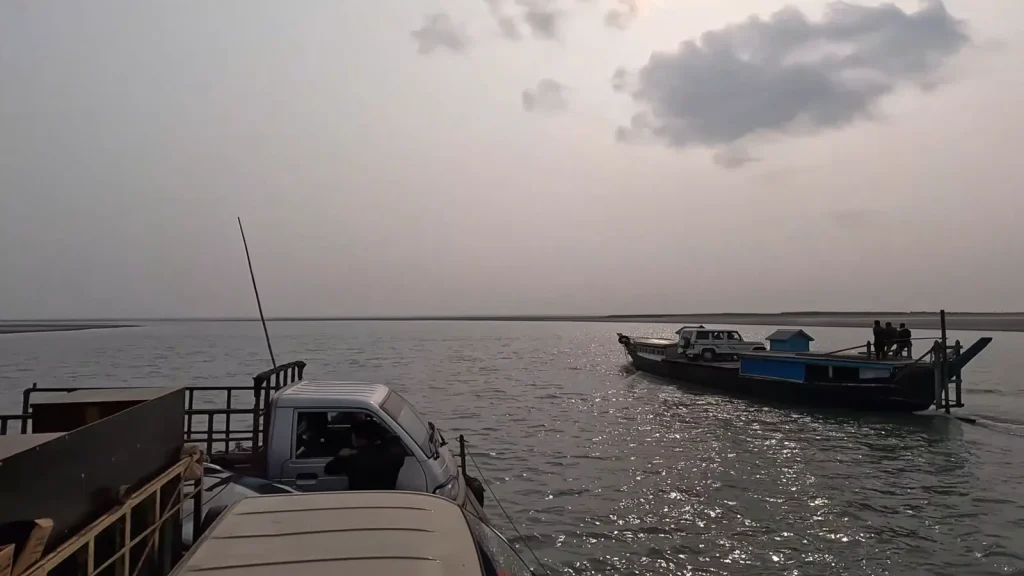
- Arrive early. If services are on the alternative ghat, expect crowds and a different transfer.
- If a sailing is cancelled, ask about the next one and the last one. Don’t count on a night sailing.
If you’re stuck
- Consider staying on the island. The district’s list includes satra guest houses and homestays (see below).
- The district page lists road routes to Majuli from Lakhimpur (via Dhakuakhana) and Dibrugarh (via the Bogibeel Bridge). It also lists a ferry crossing on the Lakhimpur side, from Dhunaguri Ghat across the Subansiri (about 15 minutes, 7:00 AM to 5:00 PM) (district directions page). That means a road route may still involve another ferry. It isn’t a guaranteed alternative when the river is in flood, and we haven’t checked the state of these routes. The Sentinel editorial calls the road route from Jorhat long and not feasible for daily use except in emergencies. We haven’t timed it, so treat it as a last resort.
- Keep a spare day before any hard connection.
Raas Mahotsav: Planning Around the Programme

The Ministry of Tourism’s Incredible India page lists Raas Leela in Majuli for 24 to 26 November 2026. That fits the festival’s link to Kartik Purnima, which falls on Tuesday 24 November 2026 (HinduTone). But published dates vary: Assam Tourism’s festival page describes the festival as falling in the first or second week of November, and an older Assam Tourism brochure calls it a three-day festival in mid-November, while the Incredible India page says the festivities span four days. Treat the range as a guide and confirm individual satra programmes.
What to plan for: the Incredible India page says the Raas Leela is performed in 20 of Majuli’s 50 satras, and that tickets for the Garamur Satra performance are in such demand that they’re booked a month in advance. The district page says that in festival season ferries run every half hour between Nimati and both Majuli ghats, and vice versa, from 7:30 AM to 3:30 PM. In 2024, the transport minister pushed to restore the ferry before the festival, which shows how closely the two are linked. Confirm dates and tickets with the satra or the district tourism office, book your stay early, and plan to stay overnight so you aren’t racing the last sailing after an evening performance.
Where to Stay, and Who to Ask
Why stay on Majuli instead of Jorhat? Mostly because of the ferry arithmetic above. Staying on the island turns about five rushed hours into an afternoon and a morning, and it removes the pressure of the last sailing after an evening performance. An Assam Tourism brochure also says the satras have their own guest accommodation with vegetarian food, where visitors can experience monastery life or watch bhaona performances. The brochure is older, so confirm current arrangements. Staying in Jorhat has its own case: more choice, easier airport and rail connections, and a day trip if the ferry cooperates. The cost is that every crossing carries ferry risk.

The district administration’s page lists homestays, guest houses, bamboo cottages and satra guest houses, along with registered tourist guides and tour operators. It also names a Tourist Information Centre at Kamalabari Ghat. That’s a better starting point than a random list, because it’s official. Whichever you choose, ask which ghat guests normally use and how far it is, whether meals are included, whether they can arrange a driver or guide, and what happens if your return ferry is cancelled. We haven’t checked availability or prices for any of them.
What We Couldn’t Confirm
- Current ferry status. We found no notice for the route as of 7 November 2026, and no report of when services resumed after the July 2026 flood suspension.
- The exact timetable, in either direction. Official and published sources disagree, and intervals have varied between half-hourly, hourly and longer.
- Whether night sailings are running now. The December 2024 reports are the latest we found.
- Current fares. The only figure we found is from an older newspaper listing.
- Whether online booking is compulsory. A December 2023 report said online ticketing was made mandatory on the route, while some trip guides describe buying tickets at the counter.
- Individual Raas programmes for this year, including which satras hold performances on which days.
- Distances and times between satras. Sources differ, so the day plans above are illustrations.
- Stay availability and prices on the island.
Plan Around the River
A good Majuli trip starts with the ferry, not the sights. Find out which ghat is working, work back from the last sailing, keep a buffer for delays, and decide early whether a day gives you enough or a night is worth it. If the sums leave no slack, stay over, and keep the next day free.
Planning more of your trip? Explore our Assam guides or browse our where-to-stay guides.


Pingback: Where to Stay in Jorhat: Tea Bungalow, Town or Majuli?